
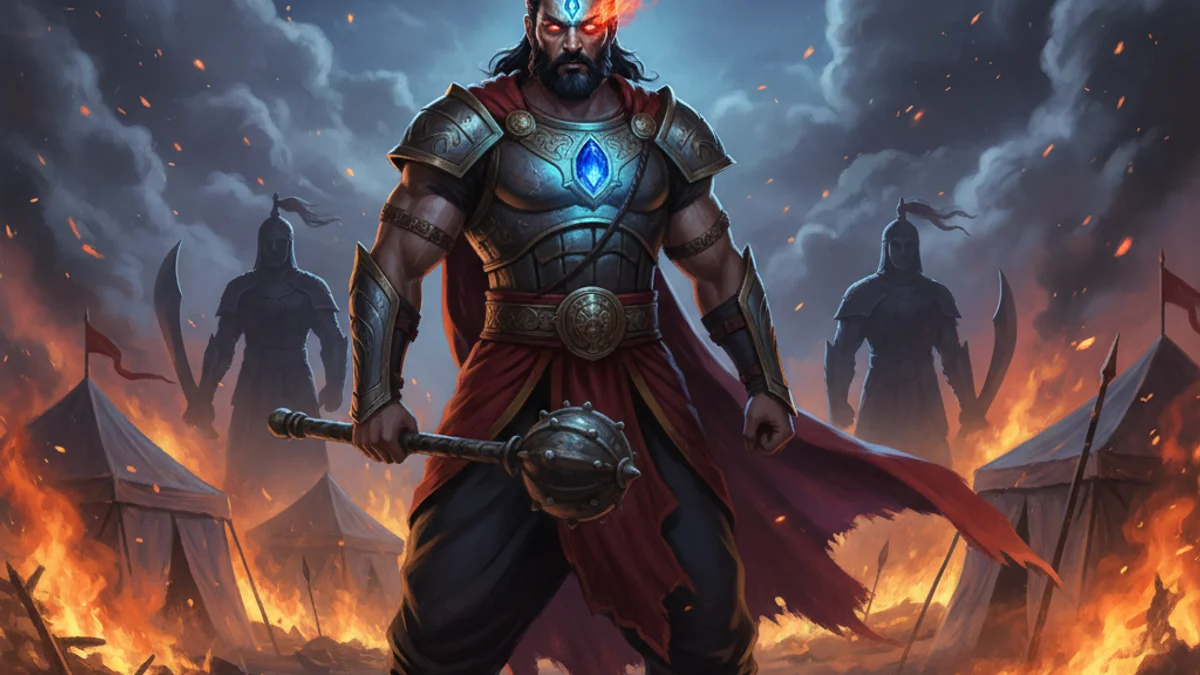
On the eighteenth night of the Kurukshetra War, Duryodhana lay dying with a broken thigh. Ashwatthama, the son of Drona, consumed by grief and fury over his father’s deceptive death and his king’s fall, sought a final vengeance. While resting under a banyan tree, he observed an owl silently slaughtering crows as they slept. Inspired by this cold efficiency, Ashwatthama decided to cast aside the kshatriya code of fair combat. Along with Kripacharya and Kritavarma, he infiltrated the Pandava camp at midnight. Driven by a dark, divine possession, Ashwatthama first strangled Dhrishtadyumna—his father’s killer—and then proceeded to massacre the sleeping warriors. In the chaos and darkness, he struck down the five Upapandavas, believing them to be the five Pandava brothers. The Pandavas themselves were away with Krishna and survived, but the night raid left their lineage decimated and the camp in ruins. This act of cowardice and brutality marked the ultimate descent of the war into mindless slaughter, leading to Ashwatthama’s eternal curse.
Revenge taken through deceit and the abandonment of ethics brings no true victory, only eternal disgrace and suffering.
Questions about this story
What is the moral of Ashwatthama's Night Raid?
The story teaches that revenge pursued through unethical means leads to a loss of humanity. It highlights that abandoning one's moral code, even in desperation, results in lasting spiritual and social consequences.
Why did Ashwatthama attack the camp at night?
Ashwatthama was driven by extreme grief over his father's death and Duryodhana's defeat. He was inspired to attack at night after watching an owl kill sleeping crows, deciding that the rules of fair war no longer applied.
Who died during Ashwatthama's Night Raid?
The primary victims were Dhrishtadyumna, Shikhandi, and the five Upapandavas (the sons of the Pandavas). Thousands of other soldiers in the Pandava camp were also killed while they slept.
Why weren't the five Pandavas killed in the raid?
The Pandavas survived because Lord Krishna, sensing the impending danger, had taken them away from the camp to the banks of the Hiranvati River that night.
Advertisement
Good night.
