
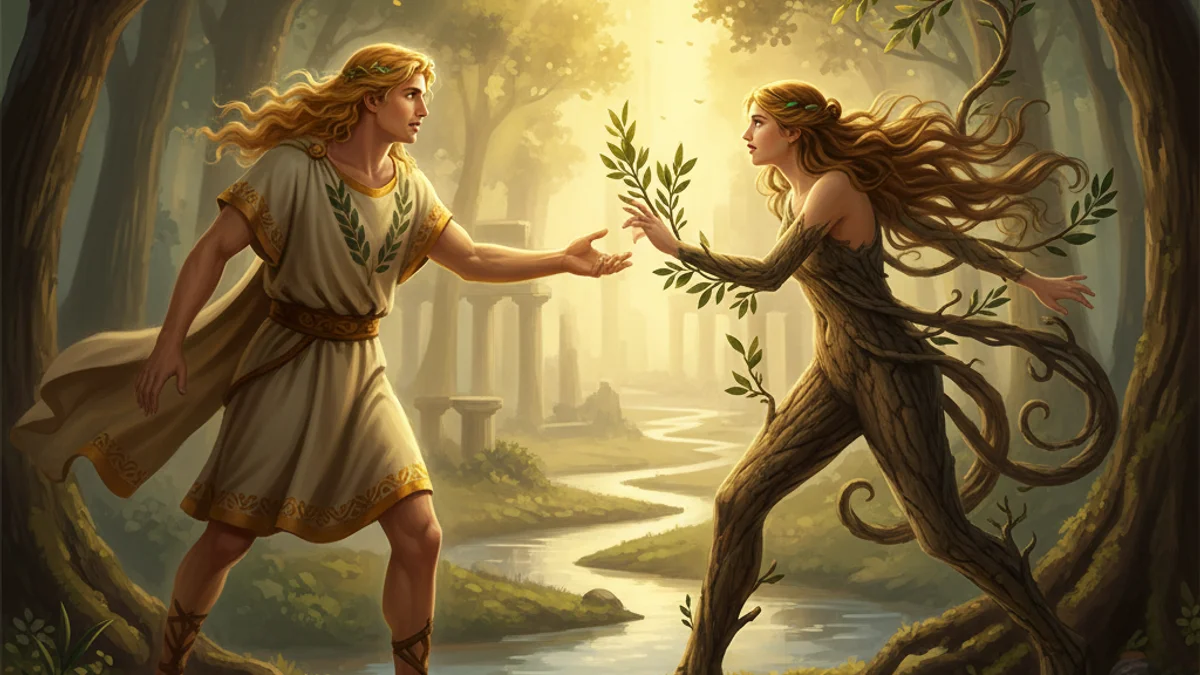
After slaying the monstrous Python, Apollo, the god of light and archery, grew arrogant. Seeing the young Eros playing with a bow, Apollo mocked him, claiming such weapons were only for great warriors. Enraged, Eros fired two arrows: a golden one to incite love into Apollo, and a leaden one to incite revulsion into the nymph Daphne. Apollo became consumed by a frantic passion, pursuing Daphne through the wild forests. Despite his status as a god, Daphne fled in terror, her heart hardened against him. Exhausted and trapped at the edge of the river Peneus, she cried out to her father, the river god, to strip away her beauty and save her. As Apollo reached to embrace her, Daphne’s skin turned to bark, her hair to leaves, and her feet to roots. She had transformed into a laurel tree. Devastated, Apollo vowed that since she could not be his wife, she would be his sacred tree, her leaves forever crowning the heads of heroes and poets.
Forced affection is not true love, and the arrogance of power can lead to eternal regret and the loss of what one desires most.
Questions about this story
What is the moral of Apollo and Daphne?
The story teaches that love cannot be forced and that obsession leads to tragedy. It also serves as a warning against arrogance, as Apollo's pride sparked the conflict with Eros.
Why did Eros make Apollo fall in love with Daphne?
Apollo insulted Eros's skills with a bow and arrow, calling him a mere child. In revenge, Eros used his divine influence to prove that his arrows were more powerful than any weapon of war.
What tree did Daphne turn into?
Daphne was transformed into a laurel tree (Laurus nobilis). This transformation allowed her to escape Apollo's pursuit while remaining rooted in the earth forever.
Who was Daphne's father in Greek mythology?
Daphne was the daughter of the river god Peneus. It was to him she prayed for salvation when Apollo was on the verge of capturing her near the riverbank.
Advertisement

Good night.
