Story Summary
Discover The Bhagavad Gita, the sacred dialogue where Lord Krishna guides Arjuna through a moral crisis on the battlefield, teaching the essence of duty and soul.
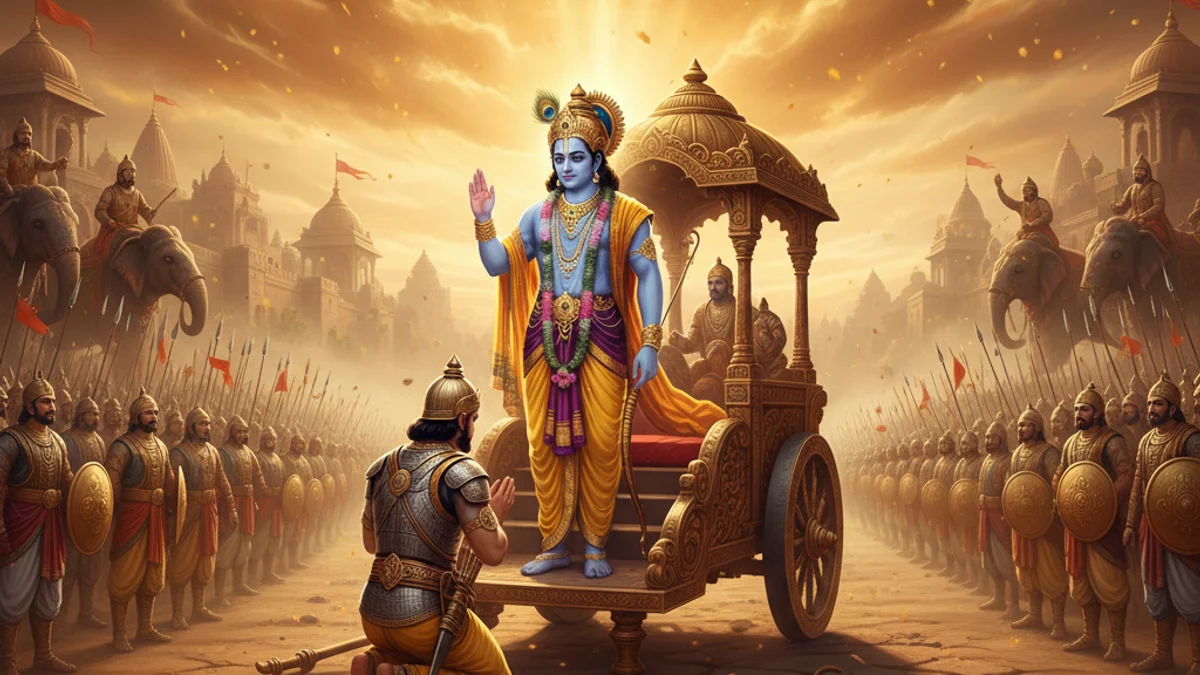
On the battlefield of Kurukshetra, the great warrior Arjuna stood frozen between two massive armies. Facing his own relatives, teachers, and friends in a war for the throne, his heart sank and he cast aside his bow, Gandiva, refusing to fight. His charioteer, Lord Krishna, who was the Supreme Being in human form, began a divine discourse to clear Arjuna's path. Krishna explained that the soul is immortal and never dies, merely changing bodies like one changes clothes. He taught Arjuna the concept of Dharma (duty) and Nishkama Karma—performing one's duty without attachment to the results. Krishna revealed his universal form, the Vishwarupa, showing Arjuna that he was merely an instrument in a larger cosmic plan. Empowered by this spiritual wisdom and the realization that righteousness must be upheld, Arjuna regained his courage and prepared for the battle, understood that his true battle was against ignorance and ego.
The Moral
Perform your worldly duties with devotion and excellence, but remain detached from the results and personal gain.
“You have a right to perform your prescribed duty, but you are not entitled to the fruits of action.”
Fun Fact
The Bhagavad Gita consists of exactly 700 verses and is often referred to as a concise guide to Hindu philosophy, capturing the essence of the Upanishads.
Frequently Asked Questions
What is the moral of The Bhagavad Gita?
The central moral is to fulfill your 'Dharma' or sacred duty without being attached to the rewards or outcomes. It emphasizes that the soul is eternal and that one should act for the sake of righteousness rather than personal desire.
Who wrote The Bhagavad Gita?
The Bhagavad Gita is traditionally attributed to the sage Vyasa, who is also the author of the larger epic, the Mahabharata. It is presented as a dialogue recorded by the scribe Ganesha as Vyasa dictated the poem.
What does the title 'Bhagavad Gita' mean?
The title translates from Sanskrit as 'The Song of God' or 'The Song of the Lord.' It represents the divine instructions given by Krishna to humanity through his conversation with Arjuna.
Why did Arjuna refuse to fight at the beginning?
Arjuna was overcome by grief and moral dilemma because the opposing army included his beloved grandsire Bhishma, his teacher Drona, and many cousins. He feared the sin of killing his own kin and the chaos that would follow such a devastating war.
What is the concept of Nishkama Karma?
Nishkama Karma is the practice of 'selfless action.' It teaches that we have a right to work, but we are not entitled to the fruits of our labor; by letting go of the results, we find inner peace and spiritual liberation.
What is the Vishwarupa mentioned in the story?
The Vishwarupa is the 'Universal Form' of Lord Krishna, a terrifying and magnificent manifestation where he reveals himself as the entire universe. This vision showed Arjuna that Krishna is the source of all creation and the ultimate destiny of all beings.
Discussion (0)
Share your thoughts on this story
No comments yet. Be the first to share your thoughts!