Story Summary
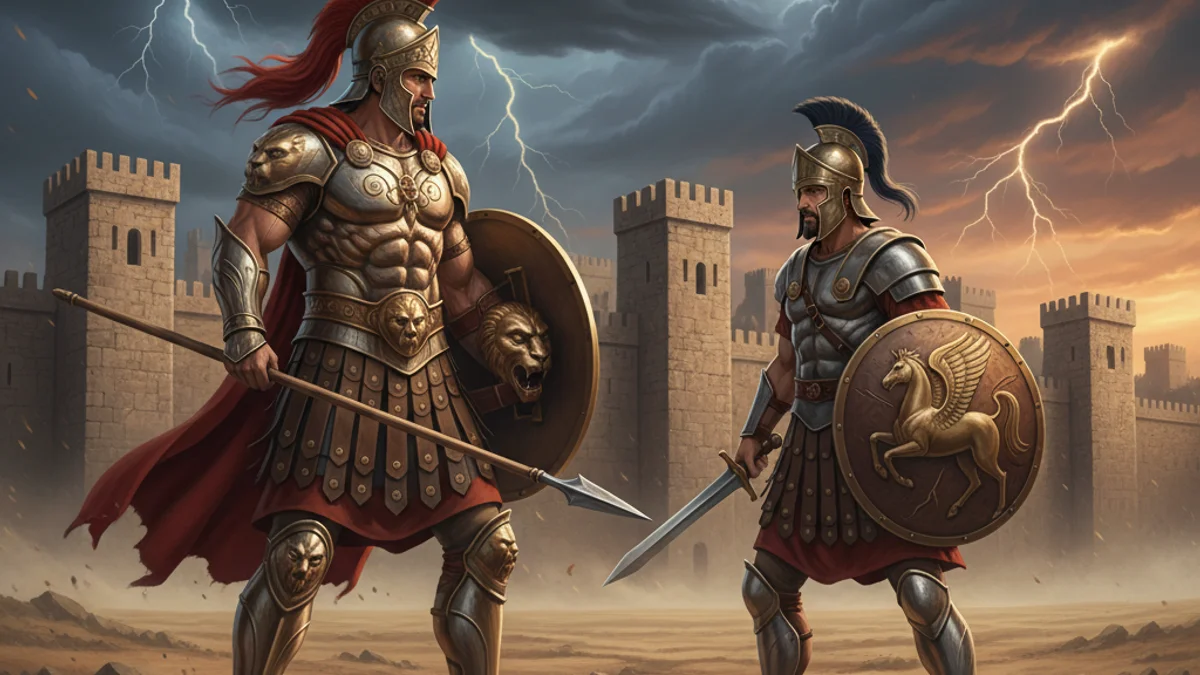
Witness the tragic climax of the Trojan War in The Death of Hector. Achilles seeks brutal vengeance against the Trojan prince in a legendary duel of fate.
Achilles, consumed by a blinding fury following the death of his companion Patroclus, returned to the battlefield of Troy with a singular purpose: to kill the Trojan prince, Hector. Outside the city’s massive Scaean Gates, Hector stood alone to face the Greek demigod, though his courage briefly failed him, and he fled three times around the city walls with Achilles in pursuit. The goddess Athena, siding with the Greeks, disguised herself as Hector’s brother Deiphobus to trick him into standing his ground. Believing he had an ally, Hector turned to face his foe. Realizing the deception too late, Hector fought valiantly but was ultimately pierced through the neck by Achilles’ spear. As he died, Hector begged for his body to be returned to his parents, but the enraged Achilles refused. He lashed the fallen prince to his chariot and dragged the body through the dust around the city, a brutal act of vengeance that only ended when King Priam personally risked his life to ransom his son’s remains.
The Moral
Uncontrolled rage can lead even the greatest heroes to cruelty, and true nobility is found in recognizing the shared humanity of one's enemies.
“I know you well as I look upon you; for in your breast you have a heart of iron.”
Fun Fact
Despite being the antagonist to the Greek protagonist, Hector was later celebrated in the Middle Ages as one of the 'Nine Worthies,' historical and legendary figures who personified the ideals of chivalry.
Frequently Asked Questions
What is the moral of The Death of Hector?
The story illustrates that uncontrolled rage leads to dehumanizing cruelty, yet human dignity must eventually be restored through mercy. It teaches that fate is inescapable for both the victor and the vanquished.
Why did Achilles refuse to return Hector's body?
Achilles was so consumed by grief and 'menis' (divine wrath) over the death of Patroclus that he wanted to inflict the ultimate dishonor. By dragging the body, he sought to deny Hector's soul peace in the afterlife.
How did Athena trick Hector?
Athena took the form of Hector's favorite brother, Deiphobus, appearing by his side to give him the confidence to stop running and fight. Once Hector threw his spear and turned to his brother for another, he found he was alone.
How did the duel between Achilles and Hector end?
Achilles used his knowledge of his own old armor, which Hector was wearing, to find a weakness at the throat. He delivered a fatal spear thrust, ending the life of Troy's greatest protector.
How did King Priam recover Hector's body?
Guided by Hermes, the aged King Priam snuck into the Greek camp and knelt before Achilles. He tearfully compared himself to Achilles' own father, finally breaking the hero's rage and moving him to pity.
What does Hector represent in Greek mythology?
Hector is often seen as the quintessential 'human' hero. Unlike the demigod Achilles, Hector represents domestic virtue, duty to one's family, and the tragic defense of a doomed home.
Discussion (0)
Share your thoughts on this story
No comments yet. Be the first to share your thoughts!