Story Summary
Discover the wit of Nasrudin's Duck Soup. When a single gift leads to endless guests claiming distant ties, Mulla Nasrudin serves a clever lesson in dilution.
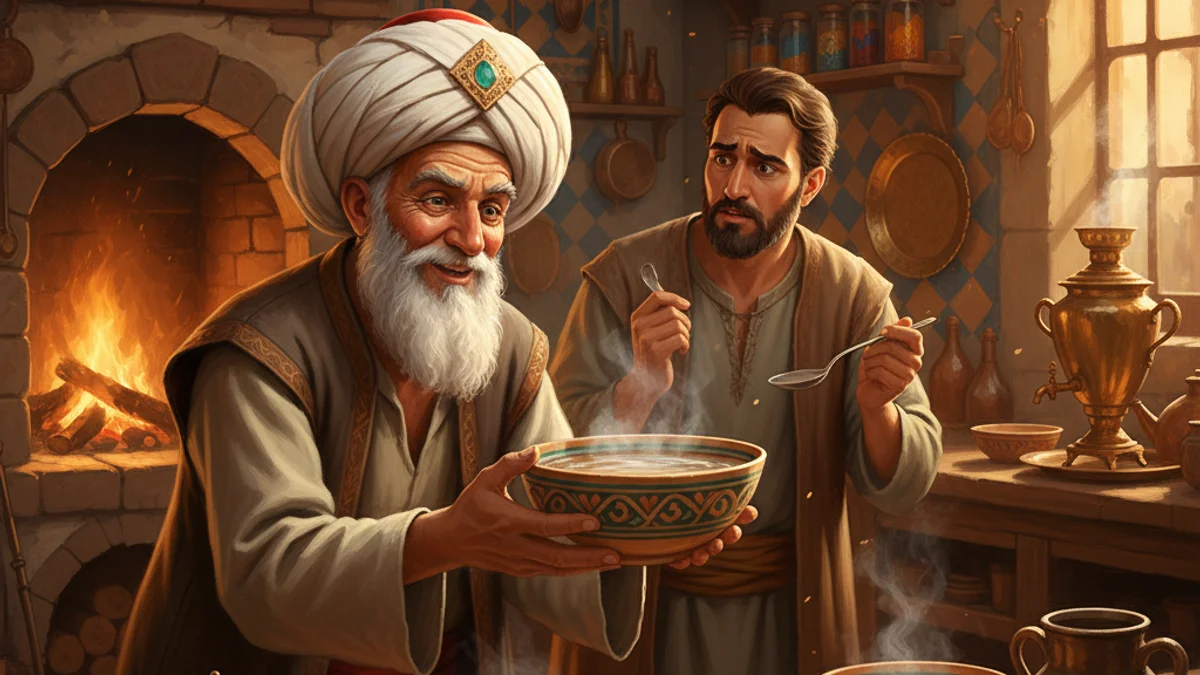
One day, a kinsman brought Mulla Nasrudin a fine duck as a gift. Nasrudin was delighted and cooked a delicious soup, sharing it with his relative. A few days later, a man knocked on his door saying, 'I am the friend of the man who brought you the duck.' Nasrudin welcomed him and served some soup. Soon after, another stranger arrived, claiming to be the 'friend of the friend of the man who brought the duck.' Nasrudin fed him too. This pattern continued until several strangers were visiting Nasrudin's home, all claiming distant connections to the original bird. Finally, a new guest arrived with a similar claim. Nasrudin set a bowl of clear, hot water before him. 'What is this?' the man asked in disappointment. Nasrudin replied calmly, 'This is the soup of the soup of the soup of the duck.'
The Moral
Substance cannot be infinitely diluted; logic and kindness should not be exploited by those with no real claim to them.
“This is the soup of the soup of the soup of the duck.”
Fun Fact
Mulla Nasrudin is a character shared by many cultures and is known by different names, such as Juha in Arabic-speaking countries or Hodja in Turkey.
Frequently Asked Questions
What is the moral of Nasrudin's Duck Soup?
The story teaches that social connections and benefits have limits. It satirizes those who try to benefit from things they have no real substance or right to claim.
Who is Mulla Nasrudin?
Mulla Nasrudin is a famous satirical Sufi figure known throughout the Middle East and Central Asia for his humorous, wise, and often paradoxical folk tales.
What does the hot water represent in the story?
The hot water represents the 'soup of the soup,' symbolizing how the value of the original gift has been completely lost through too many degrees of separation.
Is this story a critique of hospitality?
While hospitality is a sacred tradition, the story critiques the exploitation of that kindness by people who use weak excuses to take advantage of others.
How does Nasrudin use humor to teach a lesson?
Instead of arguing, Nasrudin uses the guests' own logic against them, providing a 'diluted' meal to match their 'diluted' relationship to him.
Why is this considered a Sufi parable?
Sufi parables often use absurd situations to point toward deeper truths about human nature, social dynamics, and the pursuit of sincerity over superficiality.
Discussion (0)
Share your thoughts on this story
No comments yet. Be the first to share your thoughts!