Story Summary
Discover the wisdom of Nasrudin and the Moon. A humorous Sufi parable about Mulla Nasrudin’s attempt to rescue the moon's reflection from a deep garden well.
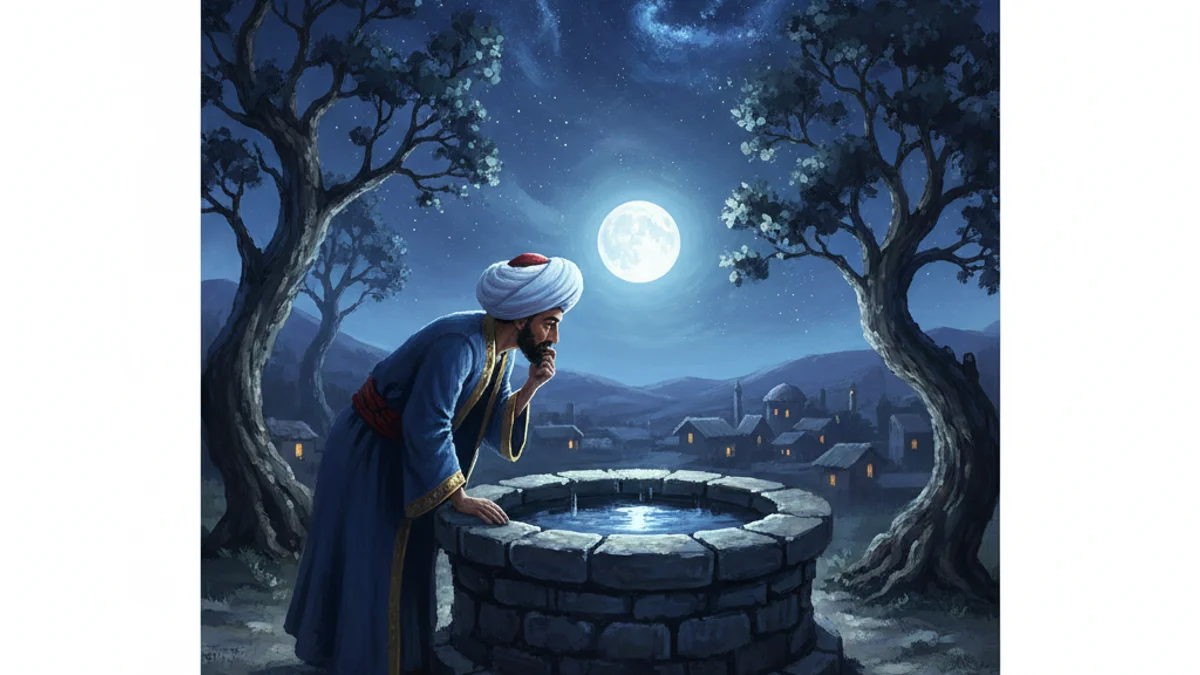
One night, Mulla Nasrudin looked into his garden well and was horrified to see the moon shimmering at the bottom of the water. 'The moon has fallen into the well!' he cried out. 'I must rescue it immediately.' He ran to fetch a long rope with a sturdy hook attached to the end. Lowering the hook into the dark depths, he waited until he felt it snag onto something heavy. Nasrudin pulled with all his might, straining his muscles against the weight. Suddenly, the hook slipped from the stone it had caught, and the force sent Nasrudin flying backward onto the ground. As he lay flat on his back, gasping for air, he looked up and saw the full moon shining brightly in the night sky. He smiled with great satisfaction and said, 'It was a difficult struggle and I have a sore back, but at least the moon is back where it belongs.'
The Moral
We often act upon false assumptions and take personal credit for the natural order of the universe.
“It was a hard struggle, but at least I got the moon back into its place.”
Fun Fact
Mulla Nasrudin is a beloved figure in many cultures and is known by various names, including Juha in Arabic and Hoca in Turkish.
Frequently Asked Questions
What is the moral of Nasrudin and the Moon?
The moral is that our perceptions are often flawed and we frequently misinterpret reality based on appearances. It also satirizes human ego, showing how we take credit for events we didn't actually influence.
Why did Nasrudin think the moon was in the well?
He saw the moon's reflection on the surface of the water and mistook the image for the physical object. This highlights the Sufi theme of mistaking the 'shadow' or reflection for the 'Truth'.
Who is Mulla Nasrudin in Sufi literature?
Nasrudin is a populist philosopher and 'wise fool' found in folklore across the Middle East and Central Asia. His stories use humor to transmit deep spiritual and psychological insights.
What does the moon symbolize in this story?
While the moon often represents divine light, in this specific tale, it serves as a tool to show the absurdity of human logic and the limitations of the physical senses.
Is the story of Nasrudin and the Moon a true story?
It is a teaching parable rather than a historical account. These tales are meant to be 'mirrors' that show the reader their own foolishness and biases through laughter.
What does the well represent in Nasrudin tales?
The well often represents the depth of the subconscious or the narrowness of a person's worldview. In this story, it acts as a trap for those who only look at the surface of things.
Discussion (0)
Share your thoughts on this story
No comments yet. Be the first to share your thoughts!