Story Summary
Discover how Lord Vishnu took the fierce avatar of Narasimha to defeat the demon king Hiranyakashipu and save Prahlad in this epic and powerful Puranic tale.
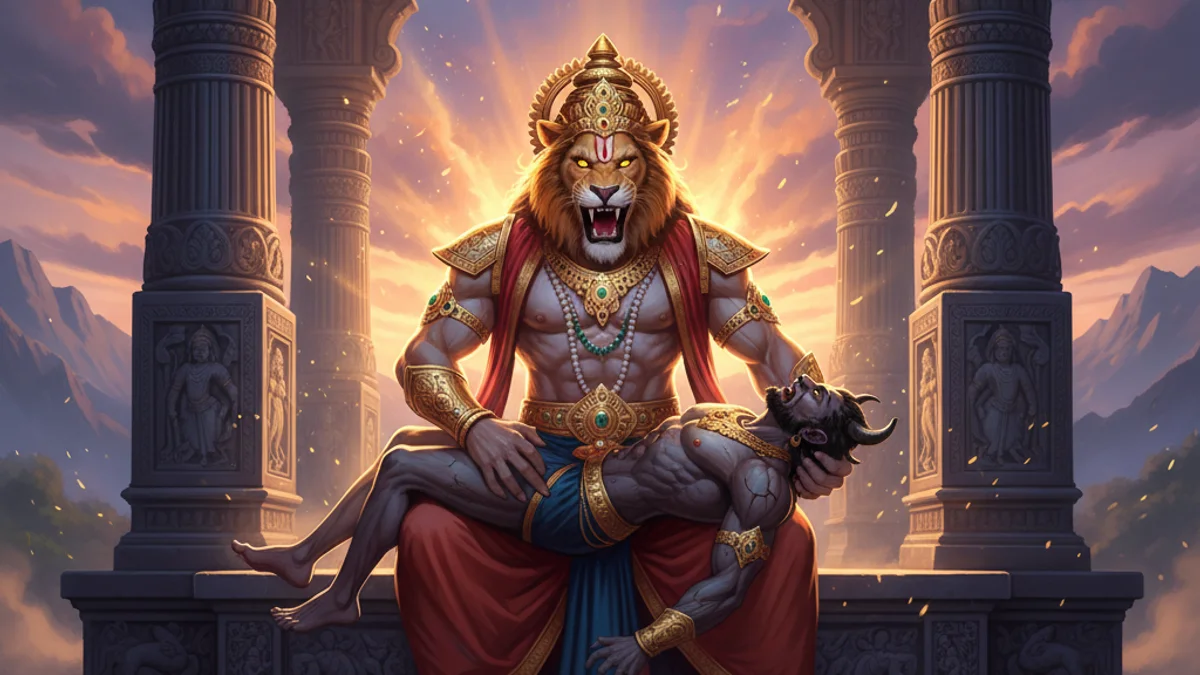
The demon king Hiranyakashipu, through intense penance, secured a unique boon from Brahma: he could not be killed by man or beast, indoors or outdoors, during day or night, by any weapon, or on the ground or in the sky. Emboldened, he declared himself God and banned the worship of Lord Vishnu. However, his young son, Prahlad, remained a steadfast devotee of Vishnu. Furious at this defiance, the king subjected Prahlad to numerous tortures, but the boy remained unharmed through divine grace. Finally, Hiranyakashipu challenged Prahlad, asking if his God was present in a nearby stone pillar. When the king struck the pillar in rage, Lord Vishnu burst forth as Narasimha—a creature with the head of a lion and the body of a man. He carried the demon to the threshold of the palace at twilight. Placing Hiranyakashipu on his lap, Narasimha tore him apart with his claws, fulfilling every condition of the boon and restoring cosmic balance.
The Moral
No matter how clever or powerful evil becomes, divine justice and pure devotion will always prevail over ego and tyranny.
“Neither by man nor beast, neither by day nor night—the Lord transcends all boundaries to protect the righteous.”
Fun Fact
Narasimha is considered the fourth avatar of Lord Vishnu, and his story is a classic example of 'divine logic' used to overcome impossible loopholes.
Frequently Asked Questions
What is the moral of Narasimha Defeats Hiranyakashipu?
The story teaches that faith and devotion are more powerful than any worldly strength or ego. It also shows that the Divine will always find a way to protect the righteous and uphold justice.
Why did Vishnu take the form of Narasimha?
Vishnu became Narasimha to bypass the specific conditions of Hiranyakashipu's boon. Since the king could not be killed by man or beast, a half-man, half-lion form was necessary to slay him.
What were the conditions of Hiranyakashipu's boon?
He could not be killed by any created being, indoors or outdoors, at day or night, by any weapon, or on the earth or in the sky. This made him feel immortal and untouchable.
Who was Prahlad in the story?
Prahlad was the son of Hiranyakashipu and a devout follower of Lord Vishnu. Despite his father's attempts to kill him for his faith, Prahlad remained unharmed and eventually witnessed the Lord's manifestation.
How did Narasimha fulfill the conditions of the boon?
Narasimha killed the king at twilight (neither day nor night), on a doorway threshold (neither inside nor out), with his claws (no weapon), and on his lap (neither earth nor sky).
What does Narasimha symbolize in Hinduism?
Narasimha symbolizes the omnipresence of God and the destruction of evil. He represents the idea that God is present even in inanimate objects like pillars to protect his devotees.
Discussion (0)
Share your thoughts on this story
No comments yet. Be the first to share your thoughts!