
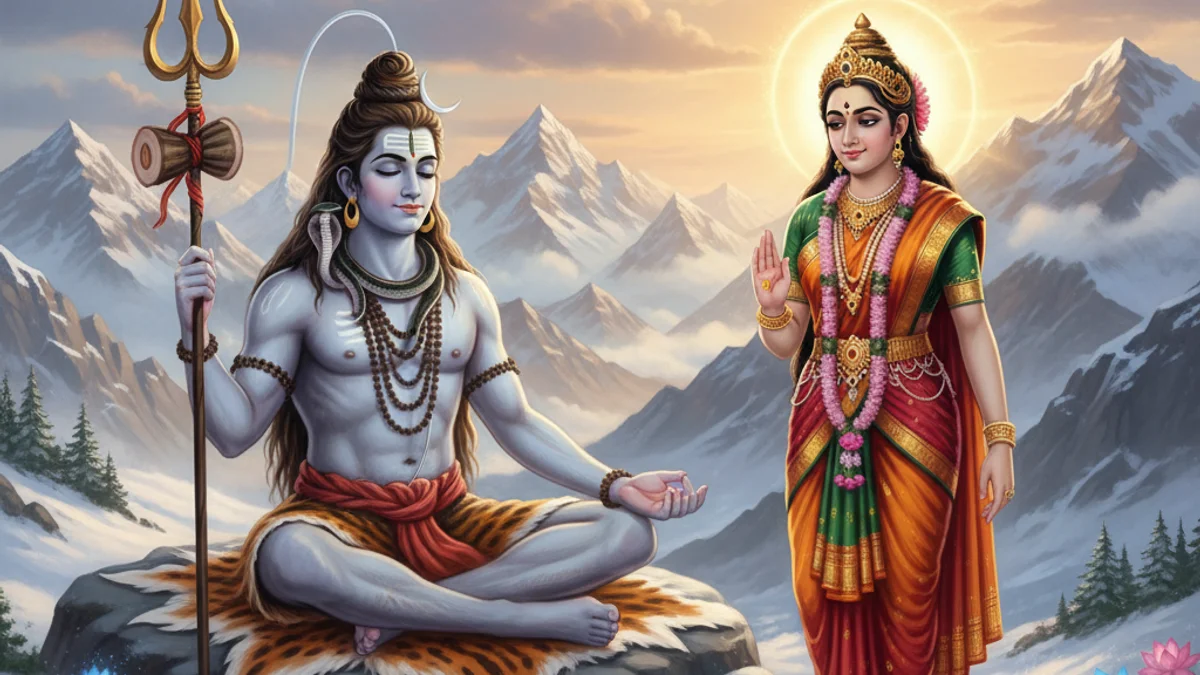
After the tragic loss of Sati, Lord Shiva withdrew into the deep icy caves of the Himalayas, submerged in profound meditation. Sati was reborn as Parvati, the daughter of King Himavan. From a young age, she was determined to win Shiva's heart. Despite his ascetic nature and rejection of worldly desires, Parvati embarked on a path of intense penance (tapas). She gave up food and water, standing amidst fires in summer and freezing waters in winter, chanting his name. To test her devotion, Shiva appeared before her disguised as an old brahmin. He criticized Shiva, calling him a penniless wanderer who frequented cremation grounds. Parvati fiercely defended the Lord, stating that his true form was beyond human comprehension. Impressed by her unwavering resolve and pure love, Shiva revealed his true self and accepted her as his consort. Their union, celebrated as Maha Shivratri, restored balance to the universe, blending the power of consciousness (Shiva) with creative energy (Shakti).
True love and spiritual goals require unwavering devotion, patience, and the strength to look beyond external appearances.
Questions about this story
What is the moral of Shiva and Parvati?
The story teaches that persistence and selfless devotion can bridge the gap between the human and the divine. It emphasizes that inner character is far more important than outward appearance or status.
Who was Parvati in her previous life?
Parvati was the reincarnation of Sati, Shiva's first wife, who immolated herself to defend her husband's honor. Her rebirth as Parvati allowed her to reunite with Shiva in a more stable form.
Why did Parvati perform such intense penance?
She sought to prove that her love was not based on physical attraction but on a deep spiritual connection. Her penance was meant to match Shiva's own level of asceticism and discipline.
What does the union of Shiva and Parvati represent?
Their union represents the concept of Shiva and Shakti—the inseparable relationship between consciousness and energy. Together, they maintain the cosmic order and the cycle of creation.
Advertisement



Good night.
