Story Summary
Discover how the Camel got its hump in this classic Kipling fable. Learn why laziness and a 'humph' resulted in a permanent physical reminder to work hard.
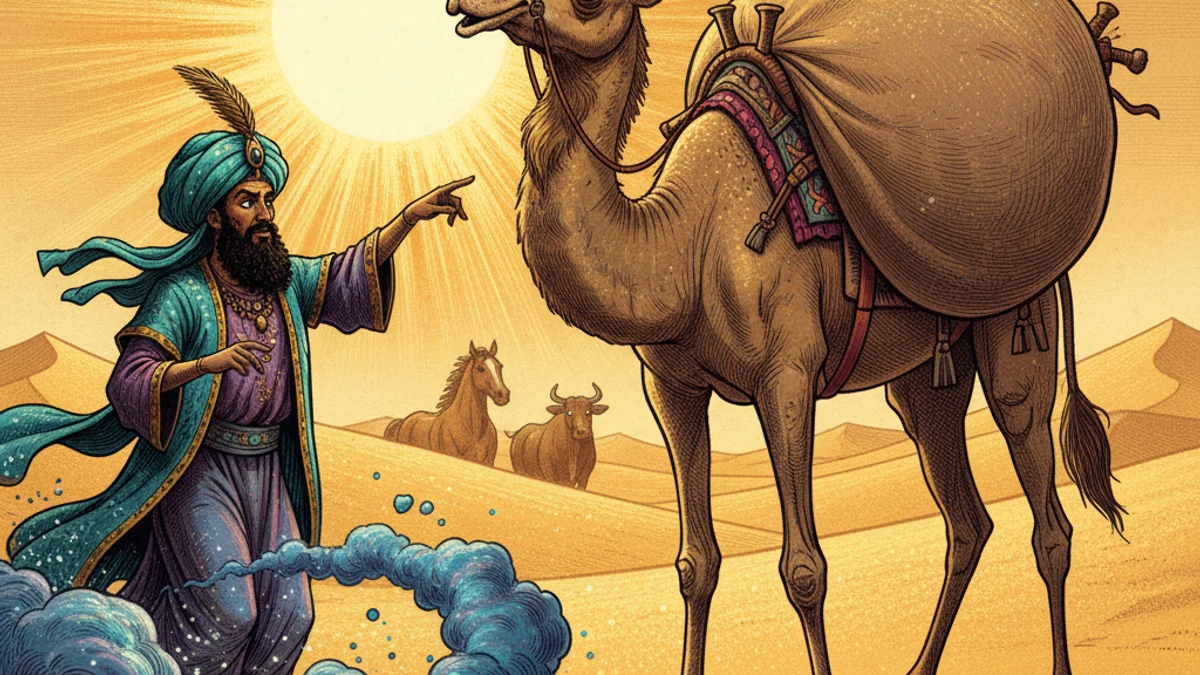
In the beginning of years, when the world was new and animals were just beginning to work for Man, there lived a Camel in the middle of a Howling Desert. He was exceedingly lazy and refused to do any work. When the Horse, the Dog, and the Ox came to him on separate days asking for his help, he merely replied, 'Humph!' The three animals complained to the Djinn in charge of All Deserts about the Camel's idleness. The Djinn found the Camel looking at his reflection in a pool of water and told him he must work for the others. The Camel, arrogant as ever, simply said, 'Humph!' In an instant, the Djinn blew a great spell. The Camel's back began to puff and swell into a giant, wobbly lump. The Djinn explained that this 'humph'—now a hump—was a physical manifestation of his laziness. Because he had missed three days of work, the hump would allow him to live and work for three days without eating, carrying his food on his back. To this day, the Camel wears his hump as a reminder of the work he failed to do.
The Moral
Idleness and arrogance lead to consequences that one must carry forever; everyone must do their fair share of work.
“The Camel’s hump is an ugly lump which well we may see at the Zoo; but uglier yet is the hump we get from having too little to do.”
Fun Fact
Rudyard Kipling originally illustrated the first edition of the 'Just So Stories' himself, including a drawing of the Camel looking at his reflection.
Frequently Asked Questions
What is the moral of How the Camel Got Its Hump?
The moral is that laziness and refusing to contribute to society have lasting consequences. It teaches that everyone has a responsibility to work and that idleness is a burden we must eventually carry.
Who wrote the original story of How the Camel Got Its Hump?
The story was written by Rudyard Kipling as part of his 'Just So Stories' collection, published in 1902. Kipling wrote these tales for his daughter, Josephine, using a rhythmic and playful style.
Why did the Camel only say 'Humph'?
The Camel said 'Humph' out of pure laziness and arrogance, refusing to engage with the other animals or the Man. It was his way of dismissing his duties and expressing his lack of interest in working.
What does the hump represent in the story?
The hump represents the three days of work the Camel missed at the beginning of the world. It is a physical manifestation of his 'humph' and serves as a tool to help him work longer to make up for lost time.
Who is the Djinn in the story?
The Djinn is the magical spirit in charge of 'All Deserts.' He acts as a mediator and a figure of justice who uses his magic to punish the Camel's laziness while giving him the means to eventually rectify it.
What kind of story is How the Camel Got Its Hump?
It is a 'pourquoi' tale, which is a fictional narrative that explains why something in nature is the way it is. These stories are common in folklore to explain animal traits or natural phenomena.
Discussion (0)
Share your thoughts on this story
No comments yet. Be the first to share your thoughts!