Story Summary
Experience the haunting tale of Yuki-onna the Snow Woman, a Japanese legend about a woodcutter who survives a deadly frost and the secret that changes his life.
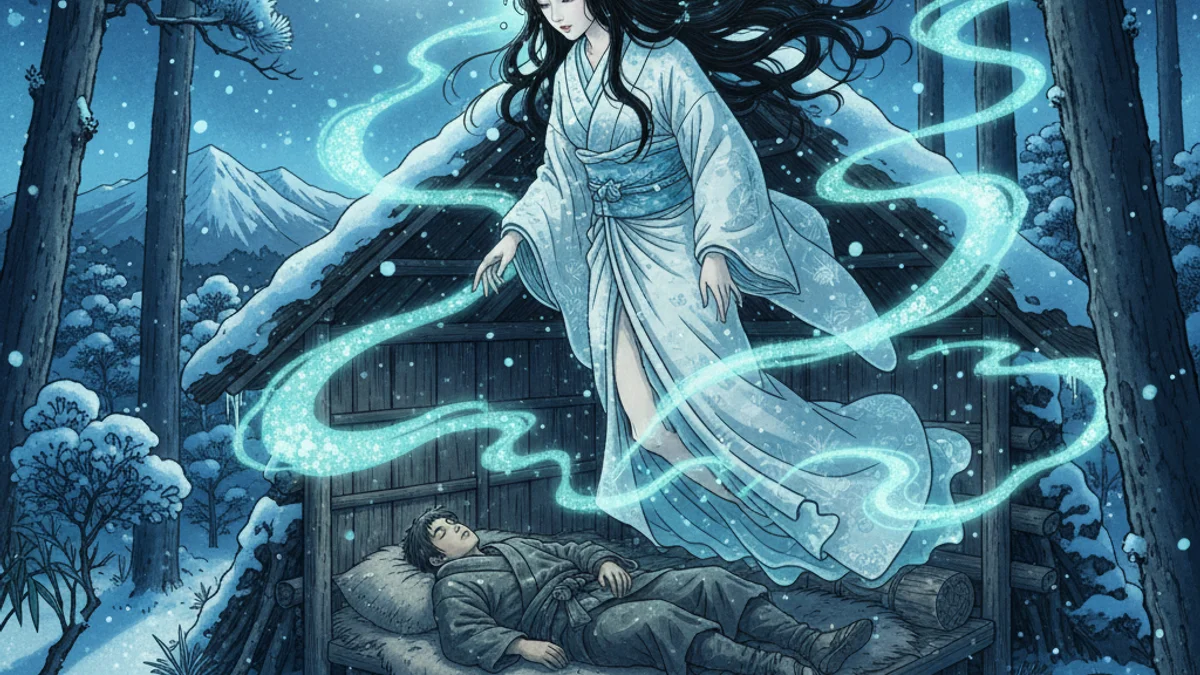
During a fierce blizzard, two woodcutters, old Mosaku and young Minokichi, took refuge in a small hut. In the middle of the night, Minokichi awoke to find a beautiful woman with skin as white as snow breathing a freezing mist onto Mosaku, killing him instantly. She turned to Minokichi but spared him because of his youth, warning: 'If you ever mention what happened this night, I will know, and I will kill you.' Years later, Minokichi met a lovely woman named O-yuki. They married and raised several children in perfect happiness. One evening, as the snow fell, Minokichi looked at his wife and remarked how she reminded him of a mysterious snow woman he had seen in his youth. O-yuki’s face turned pale and cold. 'That woman was me,' she hissed. 'I promised to kill you if you spoke of it, but for the sake of our children, I shall spare your life once more. But I can stay no longer.' She melted into a white mist and vanished through the chimney, never to be seen again.
The Moral
The importance of keeping one's word and the fragility of trust, as even a single broken promise can destroy a lifetime of happiness.
“I told you that I would kill you if you ever spoke of that night.”
Fun Fact
Lafcadio Hearn, who popularized the story, claimed he was told this version by a farmer in the Musashi Province who swore it was a true local legend.
Frequently Asked Questions
What is the moral of Yuki-onna the Snow Woman?
The moral highlights that trust is fragile and promises must be kept. Breaking a vow, even after many years, can have irreversible consequences on one's family and happiness.
Who is Yuki-onna in Japanese folklore?
Yuki-onna is a 'yokai' or supernatural entity associated with winter and snowstorms. She is typically depicted as a beautiful woman with pale skin who leads travelers astray or freezes them to death.
Is Yuki-onna considered good or evil?
She is a complex figure who is neither strictly good nor evil. While she kills Mosaku, she also shows mercy to Minokichi and becomes a devoted wife and mother before his betrayal forces her to leave.
Why did Yuki-onna spare Minokichi?
She spared him initially because of his youth and beauty, finding him too young to die. Later, she spares him a second time after he breaks his promise because she cannot bring herself to leave their children without a father.
What happens to Yuki-onna at the end of the story?
After Minokichi reveals his secret, she transforms back into her spirit form. She berates him for his lack of silence and then dissolves into a white mist, disappearing forever into the snowy night.
Where did the story of Yuki-onna originate?
The legend originates from ancient Japanese oral traditions, specifically in the Muromachi period. It was famously recorded and popularized for Western audiences by Lafcadio Hearn in his 1904 book 'Kwaidan'.