Story Summary
Relive the historic voyage of Darwin and the Beagle. Discover how Charles Darwin’s observations in the Galapagos laid the groundwork for the theory of evolution.
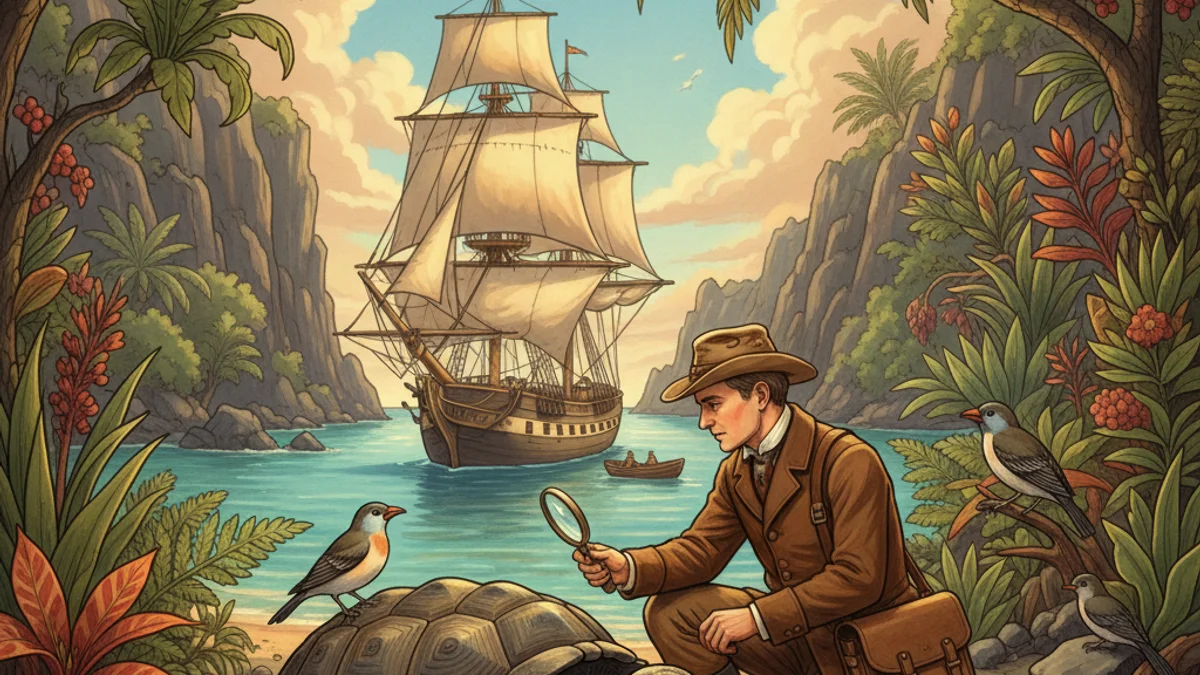
In 1831, a young naturalist named Charles Darwin set sail aboard the HMS Beagle on a five-year journey that would change the world. Initially invited as a companion to Captain Robert FitzRoy, Darwin spent his time collecting fossils and observing wildlife across South America. His most pivotal stop was the Galapagos Islands, where he noticed subtle differences between mockingbirds and tortoises on different islands. He observed that finches had varied beak shapes, each perfectly suited to their specific environment and food source. These observations planted the seeds of doubt regarding the fixity of species. Years of meticulous study after returning to England led him to formulate the theory of evolution by natural selection, forever altering our understanding of the natural world and the origins of life itself.
The Moral
Keen observation and an open mind can uncover the deepest truths of the natural world.
“On these remote islands, Darwin found the keys to the mystery of mysteries.”
Fun Fact
Darwin was actually a second choice for the voyage; the position was first offered to naturalist Leonard Jenyns, who turned it down, unknowingly passing up the chance to change history.
Frequently Asked Questions
What is the moral of Darwin and the Beagle?
The story teaches that progress comes from questioning established beliefs through careful observation. It highlights how curiosity and patience can lead to revolutionary discoveries that change the course of human history.
Why were the Galapagos Islands important to Darwin?
The islands acted as a natural laboratory where Darwin observed that similar species had adapted differently to their specific environments. This provided the crucial evidence he needed to develop the concept of natural selection.
How long was the voyage of the HMS Beagle?
The voyage lasted five years, from December 1831 to October 1836. Most of this time was spent surveying the coast of South America, though the stop at the Galapagos is the most famous part.
What did Darwin's finches demonstrate?
The finches showed that beak shapes evolved over time to help the birds survive on different types of food. This suggested that species were not fixed but could change and diversify based on environmental pressures.
Who was the captain of the HMS Beagle?
Robert FitzRoy was the captain of the ship and actually invited Darwin along to serve as a scientific gentleman and social companion. Despite their later scientific disagreements, FitzRoy’s navigation was essential to the mission's success.
What book did Darwin write after the voyage?
While he published his journals as 'The Voyage of the Beagle,' his most significant work was 'On the Origin of Species,' published in 1859. This book formally introduced his theory of evolution to the scientific world.
Discussion (0)
Share your thoughts on this story
No comments yet. Be the first to share your thoughts!