Story Summary
Discover how Galileo Galilei revolutionized astronomy in Galileo and the Telescope, using his improved lenses to prove that the Earth is not the center of all.
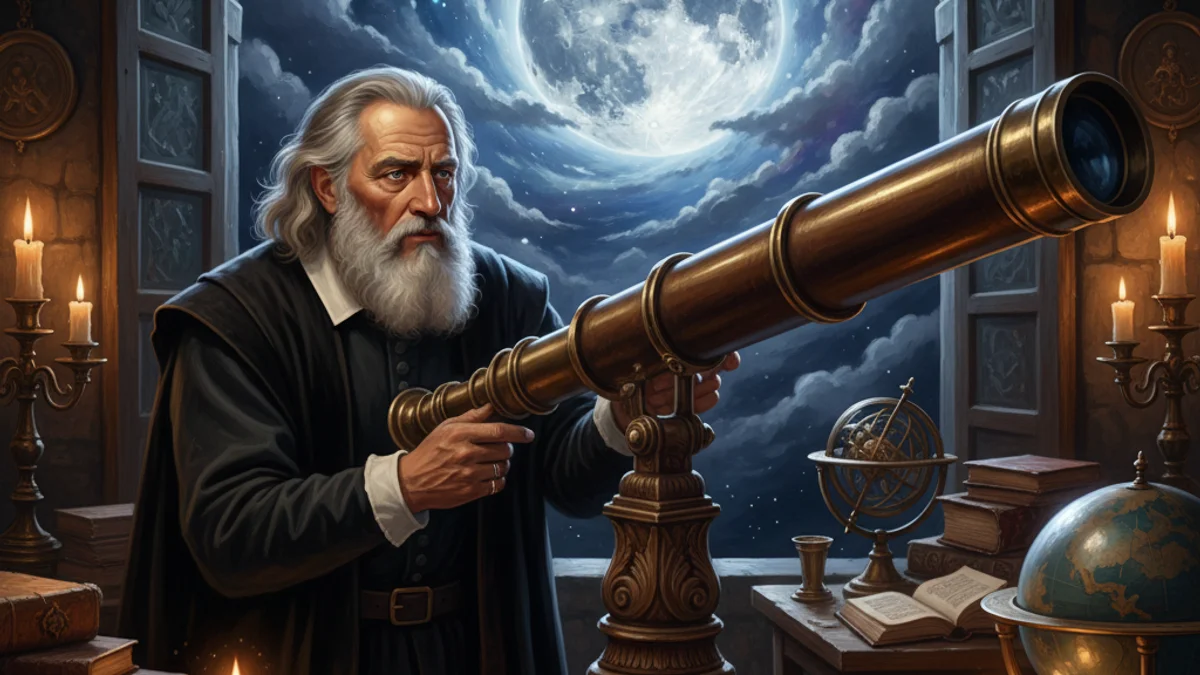
In 1609, news reached Venice of a Dutch 'spyglass' that made distant objects appear close. Galileo Galilei, a curious professor at Padua, didn't just buy one; he mastered the art of lens grinding to build his own, eventually creating a tool far more powerful than the original. While others used the device for maritime navigation and military scouting, Galileo turned his gaze toward the heavens. Through his lens, he saw mountains and craters on the moon, proving it was a jagged world rather than a perfect celestial sphere. Most shockingly, he discovered four moons orbiting Jupiter, a sight that shattered the ancient belief that all heavenly bodies revolved around the Earth. These observations provided the empirical evidence needed to support the Copernican theory that the Earth circles the sun. Despite fierce opposition and the threat of heresy, Galileo’s insistence on observation over dogma laid the foundation for modern physics and forever changed our understanding of the universe.
The Moral
The pursuit of truth requires the courage to look for oneself and the integrity to accept what the evidence reveals, even when it challenges established authority.
“In sciences, the authority of thousands of opinions is not worth as much as one tiny spark of reason in an individual man.”
Fun Fact
When Galileo first showed the moons of Jupiter to other scholars, some refused to even look through the telescope, fearing the instrument was creating an illusion.
Frequently Asked Questions
What is the moral of Galileo and the Telescope?
The story teaches that scientific truth and empirical evidence should triumph over blind adherence to tradition. It encourages us to observe the world objectively and have the courage to stand by our findings.
Did Galileo invent the telescope?
No, the first telescope was likely invented by Hans Lippershey in the Netherlands in 1608. Galileo heard about the invention and significantly improved the design to observe celestial bodies.
What were Galileo's most important astronomical discoveries?
Galileo discovered the four largest moons of Jupiter, the phases of Venus, and craters on the moon. These observations proved that not all celestial bodies revolve around the Earth.
Why was Galileo's telescope controversial?
It provided physical evidence for the Copernican theory that the Earth revolves around the Sun. This challenged the prevailing geocentric view and the religious doctrines of the time.
What happened to Galileo after his discoveries?
In 1633, the Church found him suspect of heresy for his heliocentric views. He was forced to recant and spent the rest of his life under house arrest, where he continued to write.
Why is Galileo called the father of modern science?
He pioneered the use of experimentation and the scientific method. By combining mathematical descriptions with physical observations, he moved science away from pure philosophical speculation.