Story Summary
Discover the life of Abba Moses the Black, a former bandit who became a desert saint. Learn how he turned from violence to radical peace and humble non-judgment.
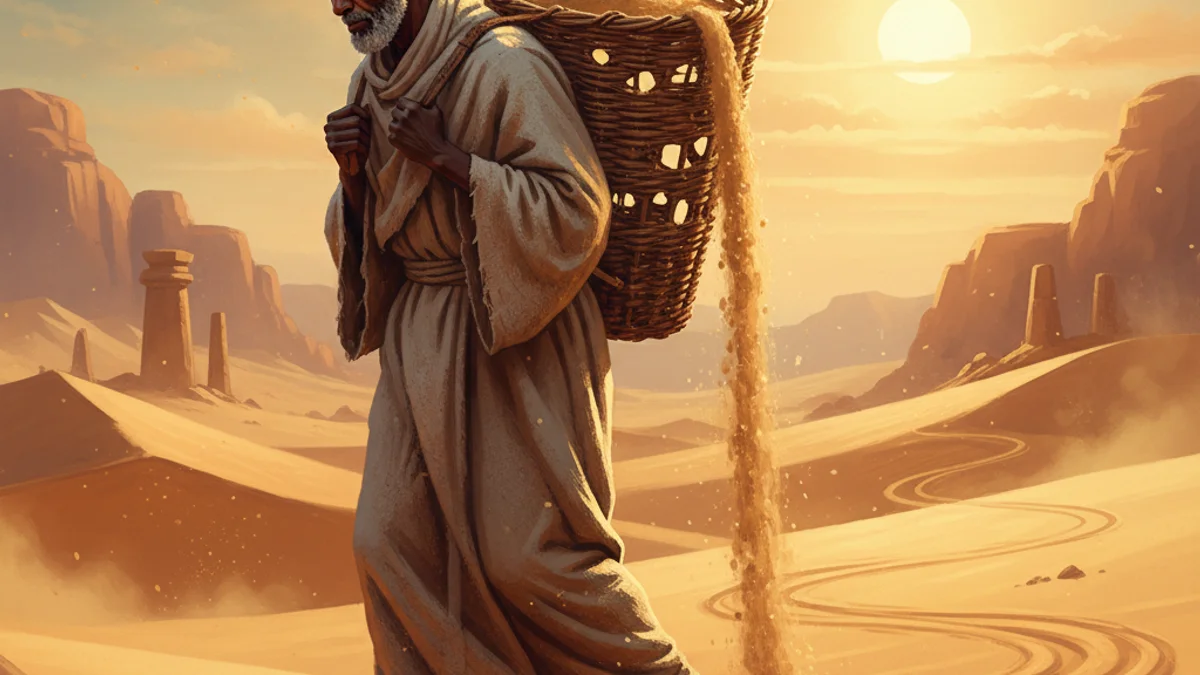
Once a fierce bandit and gang leader in 4th-century Egypt, Moses sought refuge in a monastery while fleeing the law. Though he intended only to hide, the silence of the monks and their unwavering devotion pierced his hardened heart. He renounced his violent past and entered the monastic life under the guidance of Abba Isidore. His struggle was long; his old passions often returned like desert storms, but through prayer and extreme humility, he transformed into a pillar of wisdom. The most famous tale tells of a time when the monks were called to judge a brother who had committed a fault. Moses initially refused to attend. When pressed, he arrived carrying a leaking basket of sand on his back. When the brothers asked what this meant, he replied, 'My sins run out behind me, and I do not see them, yet today I come to judge the errors of another.' Shamed by his words, the monks forgave the brother. Moses eventually died a martyr, refusing to take up arms when raiders attacked his cell, fully embodying the peace he had once sought to destroy.
The Moral
True repentance leads to radical humility, teaching us that those who recognize the weight of their own failings have no room to judge others.
“My sins run out behind me, and I do not see them, yet today I come to judge the errors of another.”
Fun Fact
Abba Moses the Black is often considered the patron saint of non-violence and is one of the most well-documented figures among the early Desert Fathers.
Frequently Asked Questions
Who was Abba Moses the Black?
He was a 4th-century Egyptian monk who was originally a notorious bandit and leader of a gang of robbers before his radical conversion to Christianity.
What is the meaning of the leaking basket of sand?
The sand represents Moses' own sins. By carrying it behind him where he couldn't see it, he illustrated that we often ignore our own faults while focusing on the sins of others.
Why is Abba Moses the Black significant in church history?
He is one of the most prominent Desert Fathers, celebrated for his teachings on non-violence, humility, and the possibility of total life transformation through repentance.
How did Abba Moses the Black die?
He was martyred by a group of Berber raiders. Despite his past as a warrior, he refused to use violence to defend himself, choosing to follow the peaceful path of Christ.
What was Abba Moses' philosophy on judgment?
He believed that a person who is preoccupied with their own spiritual growth and failings has no time or right to observe or criticize the failings of their neighbor.
Where did Abba Moses the Black live?
He lived as a monk and later a priest in the desert of Scetis in Egypt, which was a major center for early Christian monasticism.