Story Summary
Discover the wisdom of Socrates in the Marketplace, where the philosopher reveals why true happiness is found in wanting nothing from the bustling Athenian stalls.
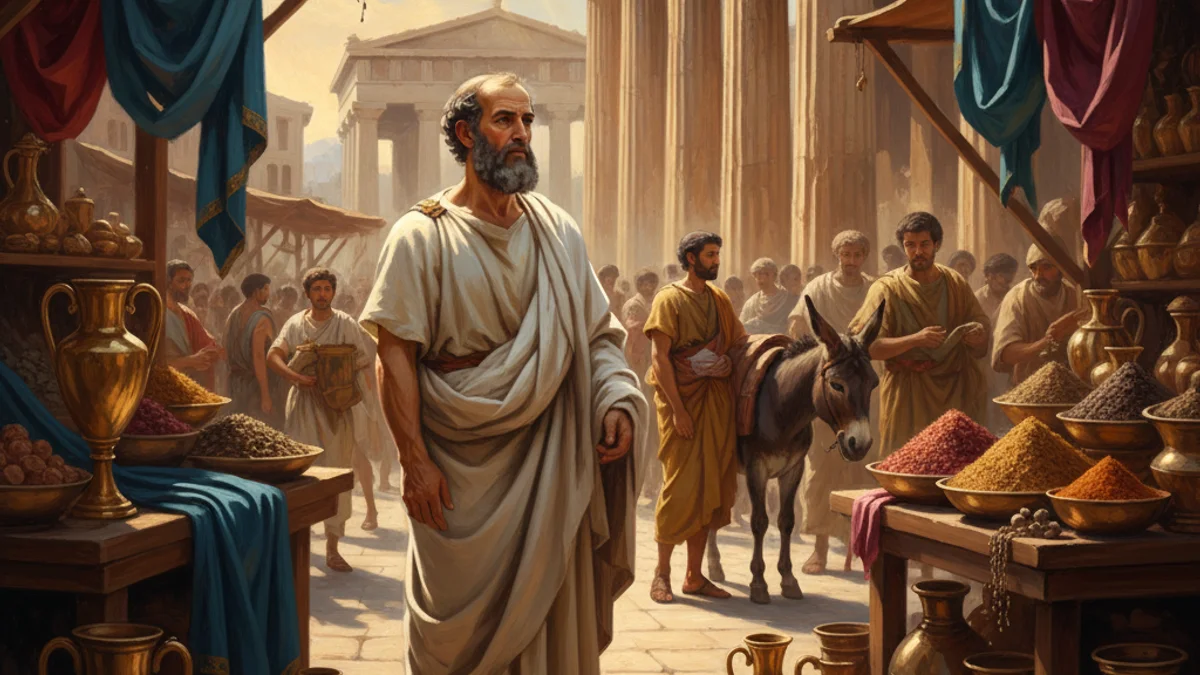
In the heart of ancient Athens, the Agora was a bustling hive of commerce, filled with exotic silks, shimmering jewelry, and fine perfumes from across the Mediterranean. While most citizens flocked to the stalls to satisfy their desires, the philosopher Socrates walked through the marketplace with a different purpose. He would spend hours observing the vast array of luxury goods on display. One day, a friend noticed his intense focus and asked, 'Socrates, why do you spend so much time looking at these riches if you have no intention of buying them?' Socrates smiled and replied, 'I love to go there and see how many things I am perfectly happy without.' For him, true wisdom lay not in the accumulation of things, but in the realization that a mind free from the burden of material desire is the greatest wealth of all.
The Moral
True happiness and freedom come from wanting less, not having more. Wisdom is found in recognizing the difference between what we need and what we merely desire.
“How many things I am perfectly happy without!”
Fun Fact
Socrates was famously known for walking barefoot even in the coldest Athenian winters, a physical manifestation of his commitment to self-discipline and simple living.
Frequently Asked Questions
What is the moral of Socrates in the Marketplace?
The moral is that true contentment stems from being satisfied with the essentials. By limiting our desires, we free ourselves from the constant pursuit of material possessions.
Why did Socrates go to the marketplace if he didn't want to buy anything?
He went to the Agora to observe human behavior and remind himself of his own independence. It served as a practical exercise in practicing his philosophy of simple living.
What did Socrates mean by his famous remark in the market?
He meant that his happiness was independent of external goods. He celebrated his freedom from the cycle of wanting and buying that consumed his fellow citizens.
Is the story of Socrates in the Marketplace historically accurate?
While it functions as a philosophical anecdote, it perfectly aligns with the accounts of Socrates' life by Plato and Xenophon. He was well-known for his ascetic lifestyle and indifference to wealth.
How did Socrates define wealth?
Socrates believed that wealth was not found in one's bank account but in the soul. To have the fewest needs was, in his view, to be nearest to the divine.
How can we apply Socratic wisdom to modern life?
In our modern consumerist culture, Socrates reminds us to question our perceived needs. He teaches that inner peace is more valuable than any product we can purchase.
Discussion (0)
Share your thoughts on this story
No comments yet. Be the first to share your thoughts!