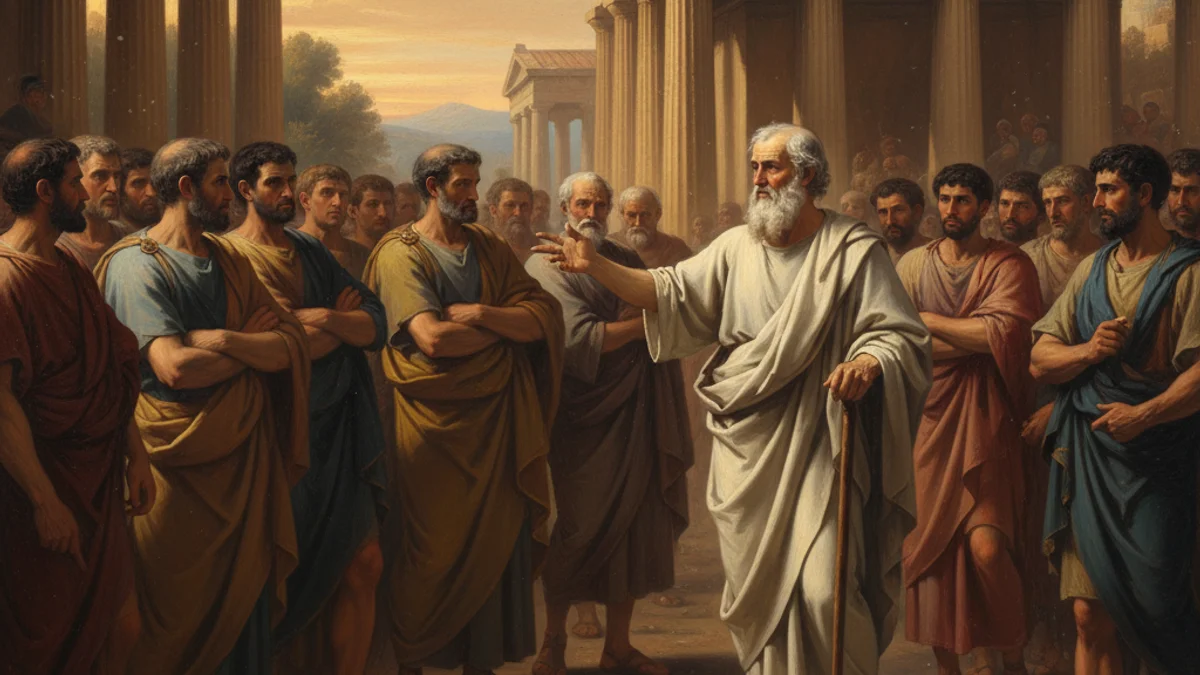
Story Summary
Discover how Pythagoras and the Blacksmith revealed the mathematical secrets of music. Explore the origins of harmonic ratios in this ancient philosophical tale.
Legend has it that as Pythagoras walked past a forge, the rhythmic clanging of hammers against anvils caught his ear. He noticed that some strikes produced beautiful harmonies, while others were harsh and discordant. Intrigued, he observed the blacksmiths at work. He realized that the pitch did not depend on the strength of the smith's swing, but on the proportions of the hammers themselves. By weighing the tools, Pythagoras discovered that musical intervals correspond to exact mathematical ratios. This revelation bridged the gap between the abstract world of numbers and the sensory beauty of music, suggesting that the entire universe might be governed by mathematical laws.
The Moral
The universe is built upon hidden mathematical harmonies that connect the physical world to the laws of nature.
“There is geometry in the humming of the strings, and there is music in the spacing of the spheres.”
Fun Fact
While the story involves hammers, the physics of sound means the legend is likely apocryphal; however, Pythagoras truly did discover these ratios using a one-stringed instrument called a monochord.
Frequently Asked Questions
What is the moral of Pythagoras and the Blacksmith?
The story teaches that beauty and harmony in the world are often rooted in logical, mathematical relationships. It encourages us to look beneath the surface of everyday events to find the underlying order of the universe.
Did the event with the blacksmith actually happen?
While historians consider this story a legend, it serves as a symbolic explanation for how the Pythagoreans discovered the relationship between vibrations and pitch. In reality, hammer weights alone do not produce these exact musical tones.
What mathematical ratios did Pythagoras discover?
He identified that an octave corresponds to a 2:1 ratio, a perfect fifth to 3:2, and a perfect fourth to 4:3. These simple numerical proportions remain the foundation of Western musical theory today.
Why is this story significant in the history of science?
It represents one of the first recorded instances of using observation and measurement to explain a natural phenomenon. It marked a major transition from mythological explanations to mathematical and scientific ones.
What is the 'Music of the Spheres'?
This is the Pythagorean belief that celestial bodies move according to the same mathematical ratios found in music. They believed the cosmos itself hums with a divine, mathematical harmony invisible to the human ear.
How did Pythagoras verify his discovery?
According to tradition, after observing the blacksmiths, Pythagoras went home and experimented with strings of different lengths and weights. He found that the same numerical ratios consistently produced the same harmonic intervals.
Discussion (0)
Share your thoughts on this story
No comments yet. Be the first to share your thoughts!