Story Summary
Discover the inspiring story of Gandhi and the Salt March, where a 240-mile journey and a handful of salt challenged British rule and sparked a revolution.
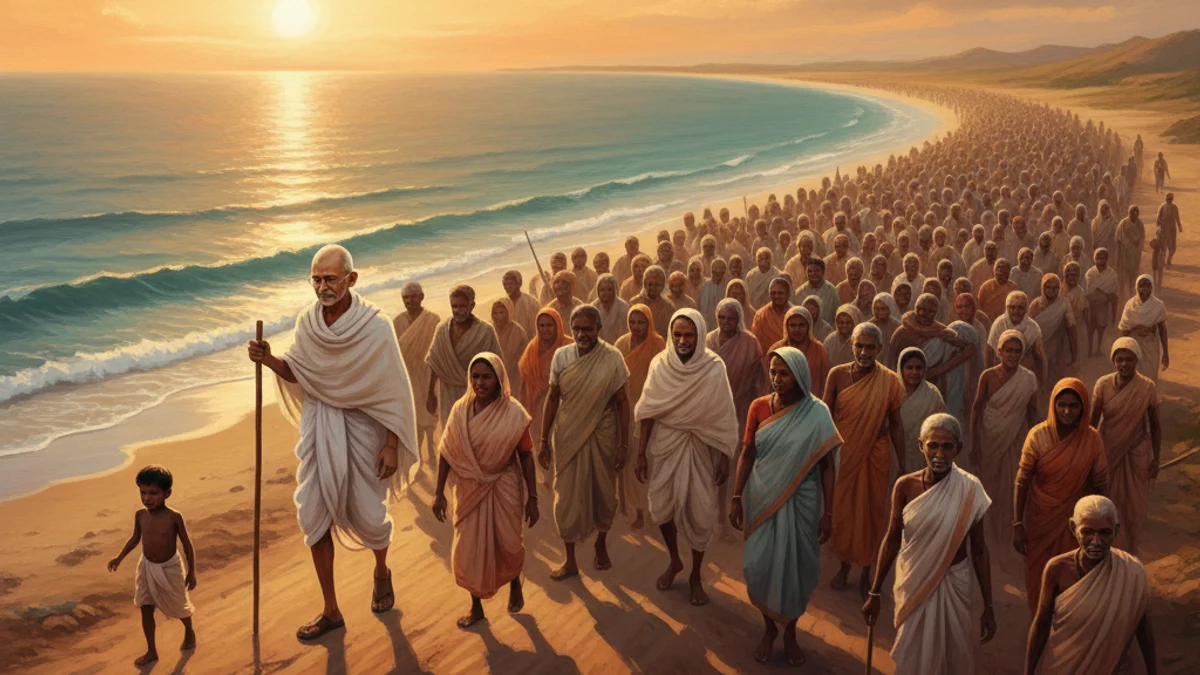
In 1930, India was under British rule, and the Salt Acts prohibited Indians from collecting or selling salt, a staple of life. Mahatma Gandhi decided to challenge this injustice through Satyagraha, or non-violent resistance. On March 12, Gandhi set out from Sabarmati Ashram with 78 followers on a 240-mile journey to the coastal village of Dandi. As they marched, thousands joined the procession, transforming a small protest into a national movement. Upon reaching the Arabian Sea on April 6, Gandhi waded into the water and picked up a small lump of natural salt from the mud. This simple act was a direct defiance of British law. It sparked a wave of civil disobedience across India, leading to the arrest of over 60,000 people. Though it took years for independence to follow, the Salt March proved that the power of peaceful truth could shake the foundations of an empire.
The Moral
Even the simplest acts of non-violent defiance can inspire a nation and topple injustice. True power lies in moral courage rather than physical force.
“With this, I am shaking the foundations of the British Empire.”
Fun Fact
Gandhi was 60 years old when he walked the 240 miles, outdistancing many younger participants during the grueling three-week journey.
Frequently Asked Questions
What is the moral of Gandhi and the Salt March?
The story teaches that non-violent resistance is a powerful tool against oppression. It shows that collective action starting from a single principled act can change history.
Why did Gandhi choose salt for his protest?
Salt was a daily necessity for everyone, regardless of caste or religion. By protesting the salt tax, Gandhi united all Indians against a law that unfairly burdened the poor.
How long was the Salt March?
The march lasted 24 days, covering approximately 240 miles from Sabarmati Ashram to Dandi. Gandhi and his followers walked about 10 miles a day to reach the coast.
What was the impact of the Salt March?
It drew worldwide attention to the Indian independence movement and proved that non-violence could challenge an empire. It led to the Gandhi-Irwin Pact and paved the way for future negotiations.
Who participated in the Salt March?
Gandhi started with 78 trusted volunteers, but the crowd grew to tens of thousands. Leaders like Sarojini Naidu also joined him at the coast to support the cause.
What does Satyagraha mean?
Satyagraha translates to 'truth force' or 'soul-force.' It is a philosophy of non-violent resistance coined by Gandhi to fight social and political injustice.
Discussion (0)
Share your thoughts on this story
No comments yet. Be the first to share your thoughts!