Story Summary
Discover the classic Panchatantra tale of The Musical Donkey. Learn why a donkey's ill-timed singing in a cucumber field led to a painful lesson in wisdom.
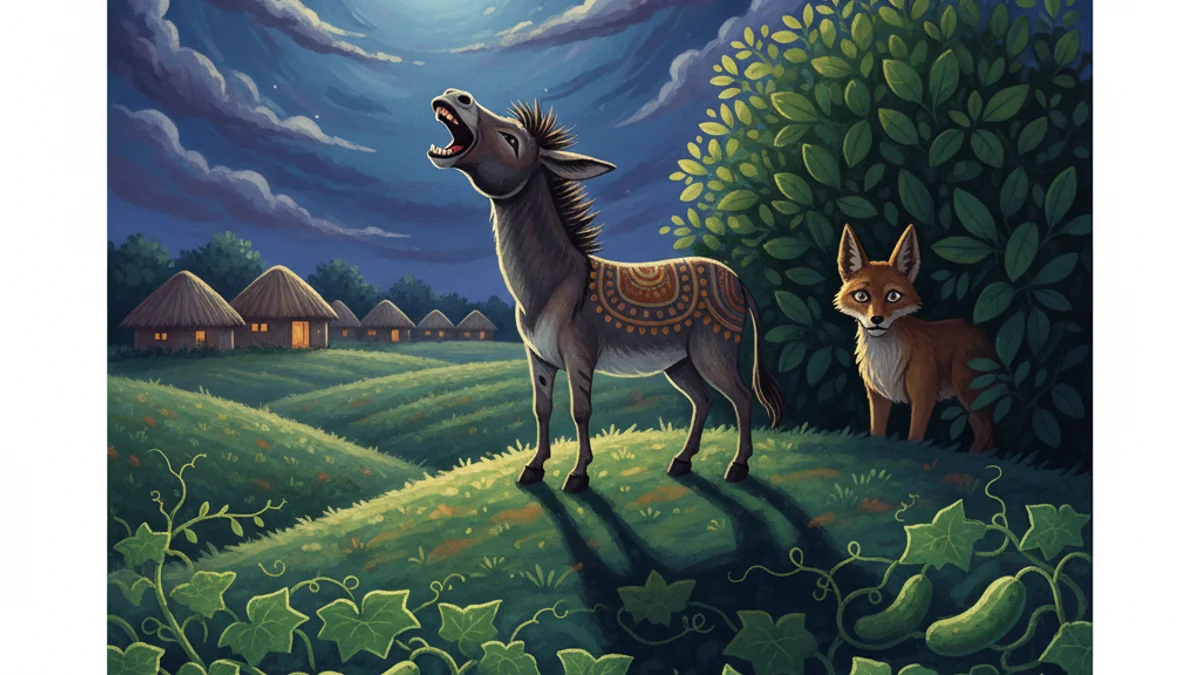
A washerman’s donkey and a jackal became unlikely friends, spending their nights raiding lush cucumber fields together. One moonlit night, after feasting until his belly was full, the donkey felt an irresistible urge to sing. The jackal, sensing immediate danger, pleaded with him to stay silent, warning that his loud braying would surely alert the farmers. 'You have no appreciation for the arts!' the donkey scoffed, convinced of his own musical genius. Seeing the donkey's stubbornness, the jackal quickly hid behind a thicket. As the donkey let out a loud, discordant bray that echoed through the night, the farmers woke up and rushed to the field with sticks. They gave the donkey a sound thrashing and tied a heavy stone mortar around his neck. Limping away in pain, the donkey finally realized that his ill-timed vanity had led to his own undoing.
The Moral
There is a proper time and place for everything; acting without considering the circumstances leads to disaster.
“A song sung at the wrong time is worse than silence.”
Fun Fact
The Panchatantra is one of the most translated non-religious books in history, with versions appearing in over 50 languages across the globe for over two millennia.
Frequently Asked Questions
What is the moral of The Musical Donkey?
The moral is that there is a right time and place for every action. It teaches that ignoring wise advice and acting on impulse or vanity can lead to serious negative consequences.
Why did the donkey insist on singing in the field?
After eating a large meal of cucumbers under the beautiful moonlight, the donkey felt extremely happy and mistakenly believed he had a beautiful voice that needed to be heard.
How did the jackal react to the donkey's plan?
The jackal acted as the voice of reason, warning the donkey that his braying would wake the farmers. When the donkey refused to listen, the jackal prudently hid to avoid being caught.
What happened to the donkey at the end of the story?
The farmers, alerted by the noise, beat the donkey severely and tied a heavy wooden mortar around his neck to punish him for eating their crops and waking them.
What does the jackal symbolize in this Panchatantra story?
The jackal symbolizes practical wisdom, foresight, and the ability to recognize danger, serving as a direct contrast to the donkey's foolishness and lack of self-awareness.
Where does the story of The Musical Donkey come from?
This story is part of the Panchatantra, an ancient Indian collection of animal fables written in Sanskrit, intended to teach 'Niti' or the wise conduct of life.
Discussion (0)
Share your thoughts on this story
No comments yet. Be the first to share your thoughts!