Story Summary
Discover the classic Aesop fable The Fighting Cocks and the Eagle. A story of how pride and boasting can lead to a swift downfall after a hard-won victory.
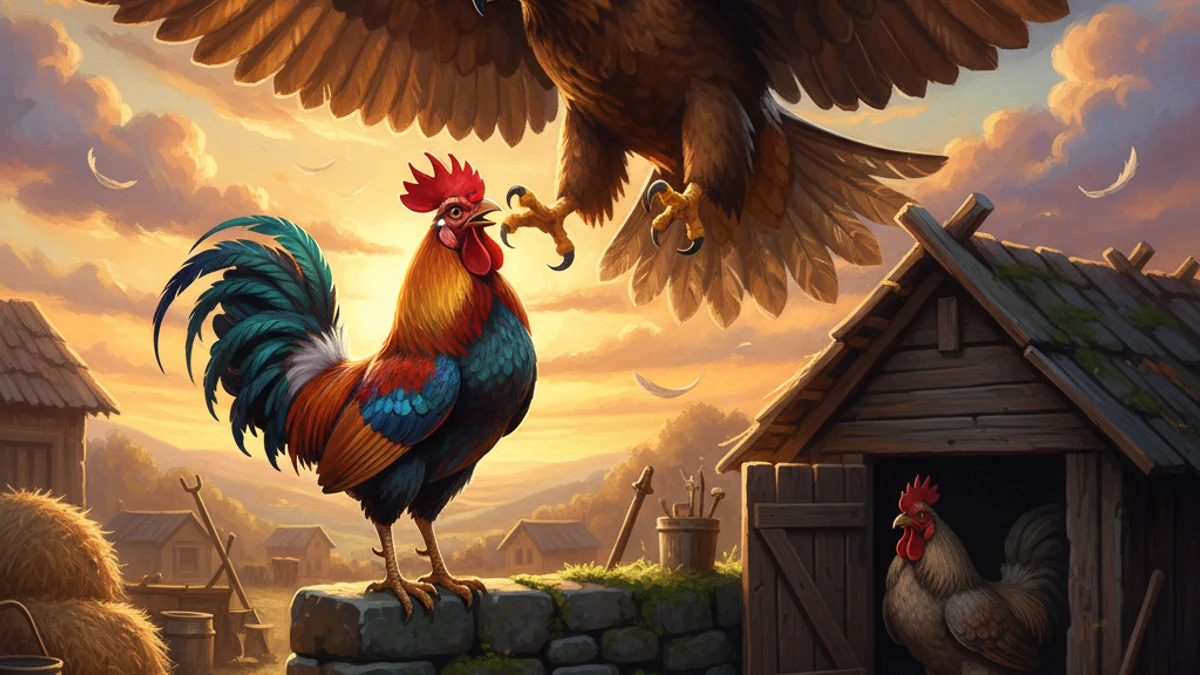
Two gamecocks fought fiercely to determine who would rule the farmyard. At last, one was defeated and slunk away to hide in a dark corner of the coop. The victor, puffed with pride, flew to the top of a high wall and flapped his wings, crowing at the top of his lungs to announce his triumph to the world. But his boasting was his undoing; an eagle, soaring high above, heard the commotion and spotted the exposed bird. In a flash, the eagle swooped down and carried the winner off in his talons. The defeated cock then stepped out from his corner and reigned over the yard undisputed.
The Moral
Pride goes before a fall, and boasting of one's success often invites destruction.
“Pride goes before destruction, and a haughty spirit before a fall.”
Fun Fact
This fable is often cited in literary studies as an early example of 'Peripeteia,' a sudden reversal of fortune where a character's own actions lead to their downfall.
Frequently Asked Questions
What is the moral of The Fighting Cocks and the Eagle?
The moral is that pride leads to destruction. Boasting about your success makes you vulnerable to new dangers, while humility can sometimes be a safeguard.
Who wrote The Fighting Cocks and the Eagle?
This story is attributed to Aesop, the legendary Greek storyteller. It is part of a collection of fables used to teach moral lessons through animal characters.
Why did the eagle take the winning cock?
The eagle was attracted by the cock's loud crowing and exposed position on the high wall. The bird's need to boast made him an easy target for the predator.
What happens to the defeated cock in the end?
The defeated cock, who had been hiding in safety, survives the ordeal. He ultimately becomes the master of the farmyard once the boastful winner is carried away.
What does the high wall symbolize in the story?
The high wall symbolizes a position of power and visibility. It represents the height of the cock's pride, which paradoxically becomes the place of his greatest peril.
How does this fable relate to real-life situations?
It serves as a warning against being overly confident after a victory. It suggests that keeping a low profile is often wiser than drawing unnecessary attention to one's achievements.
Discussion (0)
Share your thoughts on this story
No comments yet. Be the first to share your thoughts!