Story Summary
Discover the epic legend of Vishnu as Varaha, the divine boar avatar who defeated the demon Hiranyaksha to rescue Earth from the depths of the cosmic ocean.
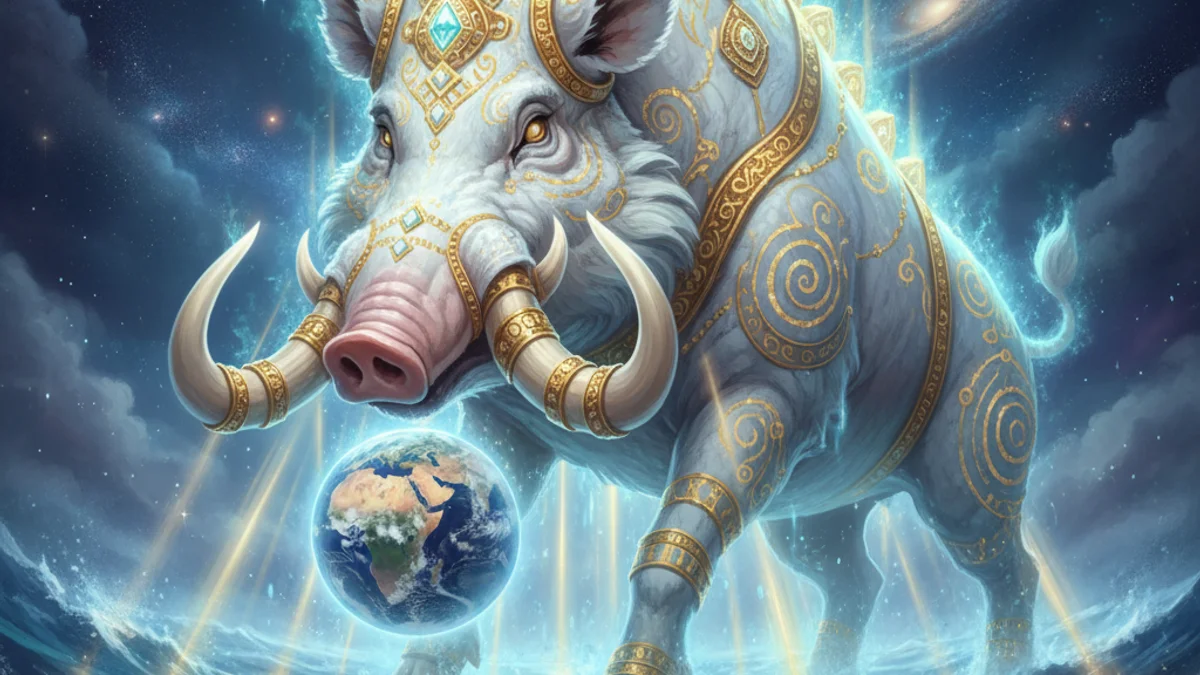
In the early ages of the universe, the demon Hiranyaksha performed severe penance to please Lord Brahma, eventually gaining a boon that made him invincible to gods, men, and beasts. Consumed by arrogance, the demon began terrorizing the three worlds. In an act of ultimate defiance, he dragged Bhumidevi (the Earth) into the depths of the primordial cosmic ocean, the Garbhodaka. With the Earth submerged and the cosmic order threatened, Lord Vishnu took his third avatar: Varaha, a colossal and radiant boar. Diving into the dark, churning waters, Varaha tracked down the demon. A fierce battle ensued between the divine boar and the gold-eyed demon that lasted for a thousand years. Finally, Varaha struck down Hiranyaksha with his mace. Gently, the Lord lifted the Earth upon his massive tusks, rising from the depths and placing Bhumidevi back in her rightful orbit, restoring balance and peace to the universe.
The Moral
The Divine will manifest in any form necessary to protect the innocent and restore cosmic balance whenever evil threatens the world.
“When the world sinks into darkness, the Divine shall rise in whatever form is needed to lift it back to light.”
Fun Fact
The Varaha avatar is often associated with the concept of 'Yajna-Varaha,' where parts of the boar's body represent different components of a Vedic sacrifice.
Frequently Asked Questions
What is the moral of Vishnu as Varaha?
The story teaches that no matter how deep the world sinks into chaos or evil, the Divine will intervene to restore Dharma. It emphasizes that protection and preservation are fundamental cosmic duties.
Why did Vishnu choose the form of a boar?
The boar was uniquely suited to navigate the muddy depths of the cosmic ocean and had the physical strength and tusks necessary to lift the heavy Earth back to the surface.
Who was the demon Hiranyaksha?
Hiranyaksha was a powerful Asura who gained near-invincibility through a boon. He is the brother of Hiranyakashipu and represents ego and the desire to control nature for selfish ends.
Which avatar is Varaha in the Dashavatara?
Varaha is recognized as the third avatar among the ten principal incarnations (Dashavatara) of Lord Vishnu, following Matsya and Kurma.
What does Bhumidevi represent in this story?
Bhumidevi is the personification of Earth. Her rescue symbolizes the preservation of life, nature, and the physical world from the forces of destruction and ignorance.
Where can one find famous depictions of Varaha?
Varaha is widely worshipped in India, with famous sculptural depictions found at the Udayagiri Caves in Madhya Pradesh and the dedicated Varaha Temple in Khajuraho.