Story Summary
Discover Till's Final Jest, the legendary trickster's last prank on the greedy townsfolk. A classic German folklore tale about legacy, wit, and vanity.
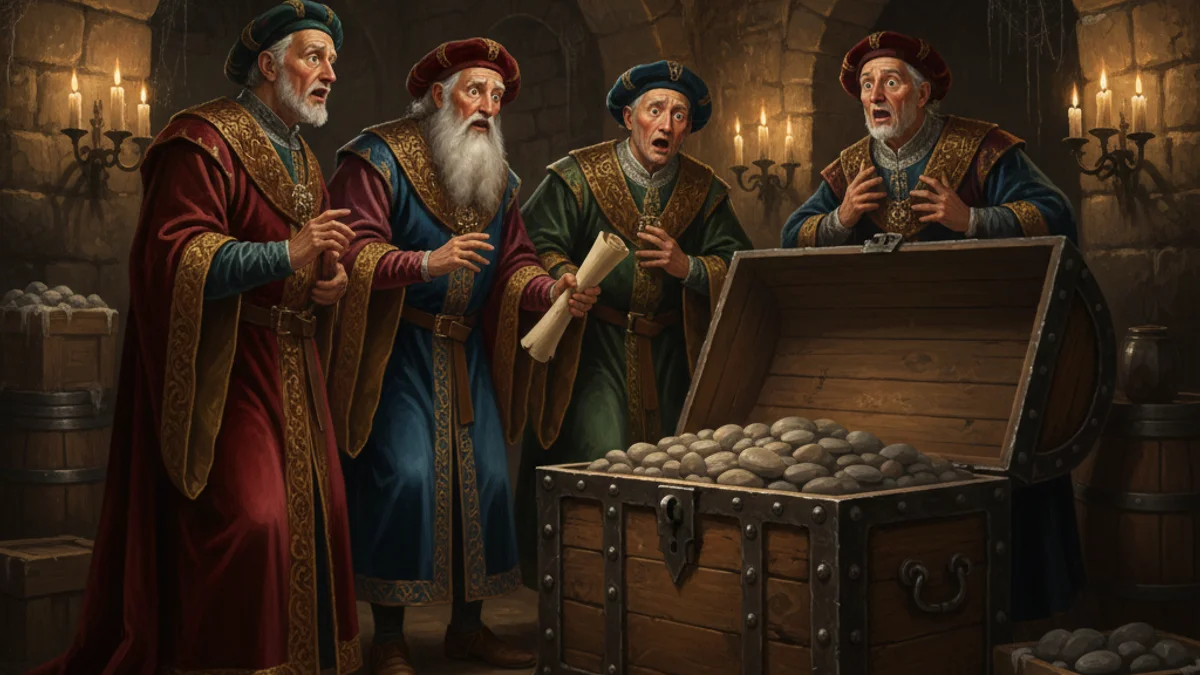
As Till Eulenspiegel lay on his deathbed, he sent for the town’s wealthiest citizens and the clergy. He claimed to have a heavy iron chest filled with gold and silver that he wished to bequeath to them, provided they buried him with honor and waited six weeks before opening the legacy. The townsfolk, blinded by the promise of riches, spared no expense for his funeral. They carried him to the grave with great pomp, dreaming of the fortune that awaited them. When the six weeks finally passed, the elders gathered with keys and hammers to prize open the heavy lid. To their horror, the chest contained nothing but common river stones and a parchment. It read: 'Even in the grave, Till makes the greedy behave like fools.' He had played his greatest trick from the beyond, proving that gold is often just weight, and greed is always a burden.
The Moral
Greed blinds people to reality, making them easy targets for deception. Even in the face of death, a clever wit can expose the vanity and avarice of the powerful.
“Even in the grave, Till makes the greedy behave like fools.”
Fun Fact
The character Till Eulenspiegel has inspired countless works of art, including a famous symphonic poem by Richard Strauss titled 'Till Eulenspiegels lustige Streiche.'
Frequently Asked Questions
What is the moral of Till's Final Jest?
The story highlights how greed can lead even the most respected members of society to act foolishly. It serves as a reminder that material wealth is fleeting, but a sharp wit leaves a lasting mark.
Who was Till Eulenspiegel in real life?
Till Eulenspiegel is a legendary figure from German folklore, believed to have lived in the 14th century. He is depicted as a peasant trickster who traveled across Europe exposing the follies of others.
What was inside the chest in Till's Final Jest?
Instead of the promised gold and silver, the chest was filled with heavy river stones and a mocking note. Till used the weight of the stones to trick the townspeople into believing they were inheriting a fortune.
Why did Till trick the townspeople from his deathbed?
Till wanted to expose the hypocrisy of the town's elite one last time. By promising them wealth, he ensured they would treat him with high honors while proving they only cared about his money.
Is Till Eulenspiegel a real historical person?
While there is debate among historians, most believe Till is a composite literary figure based on oral traditions. However, a tombstone in Mölln, Germany, is famously claimed to be his final resting place.
What does the name Eulenspiegel mean?
The name translates literally to 'Owl-Mirror.' In a medieval context, this symbolizes wisdom and self-reflection, suggesting Till held up a mirror to society's many flaws and sins.
Discussion (0)
Share your thoughts on this story
No comments yet. Be the first to share your thoughts!