Story Summary
Discover how a crow, mouse, turtle, and deer forge an unlikely bond in The Winning of Friends, a classic Panchatantra tale of wisdom and strategic alliance.
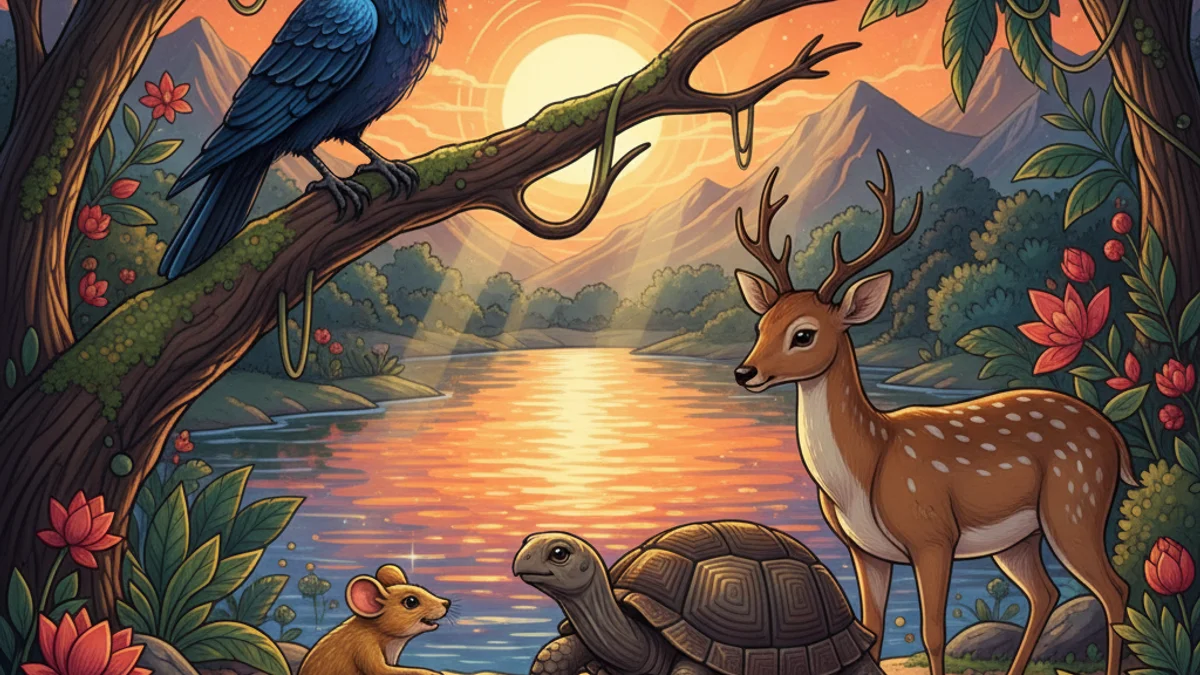
In the dense forest of the south lived a crow named Laghu-patanaka. One day, he witnessed a hunter trap a flock of pigeons, only for them to fly away together with the net. Inspired by this unity, the crow sought friendship with Hiranyaka, the mouse who had gnawed the pigeons free. Though initially hesitant, the mouse and crow became inseparable. Soon, they were joined by Mantharaka the turtle and Chitranga the deer. These four unlikely companions spent their days by a peaceful lake, sharing stories and wisdom. Their bond was tested when a hunter captured the deer. Using a brilliant strategy, the crow spotted the danger, the turtle provided a distraction, and the mouse gnawed through the leather traps while the crow kept watch. Even when the turtle was subsequently caught, the friends staged a mock death by the deer to lure the hunter away, allowing the mouse to free the turtle. Through coordinated action and unwavering loyalty, the four friends proved that wisdom and unity can overcome any predator.
The Moral
True strength lies in unity and the strategic choice of loyal friends, regardless of their size or species.
“Even a weak man can become powerful if he has the right friends by his side.”
Fun Fact
The Winning of Friends is the second book of the Panchatantra; its stories traveled through the Persian and Arabic worlds before influencing Aesop's fables and La Fontaine's works.
Frequently Asked Questions
What is the moral of The Winning of Friends?
The primary moral is that unity is strength. It teaches that even the small and weak can overcome powerful enemies if they work together and use strategic thinking.
Who are the four friends in this Panchatantra story?
The four friends are Laghu-patanaka the crow, Hiranyaka the mouse, Mantharaka the turtle, and Chitranga the deer. They represent different elements of nature working in harmony.
What does 'Mitra-labha' mean?
Mitra-labha is the Sanskrit title for this section of the Panchatantra, literally translating to 'The Winning of Friends' or 'Gaining Friends.' It focuses on how to identify and maintain valuable alliances.
How did the animals save the deer from the hunter?
The crow spotted the trapped deer from above, and the mouse used his sharp teeth to gnaw through the net. They later used a coordinated distraction involving the deer playing dead to rescue the turtle.
Why is the Panchatantra important in literature?
The Panchatantra is one of the world's oldest collections of animal fables, originally written in Sanskrit. It was designed to teach political science and practical wisdom to young princes through engaging stories.
What role does the mouse play in the story?
Hiranyaka the mouse represents the 'intellect' and 'tool-user' of the group. His ability to gnaw through traps makes him the most critical asset for physical liberation from the hunter's snares.
Discussion (0)
Share your thoughts on this story
No comments yet. Be the first to share your thoughts!