Story Summary
Discover the story of Mnemosyne and the Muses, where memory meets inspiration to birth the arts that define human culture and divine wisdom in Greek myth.
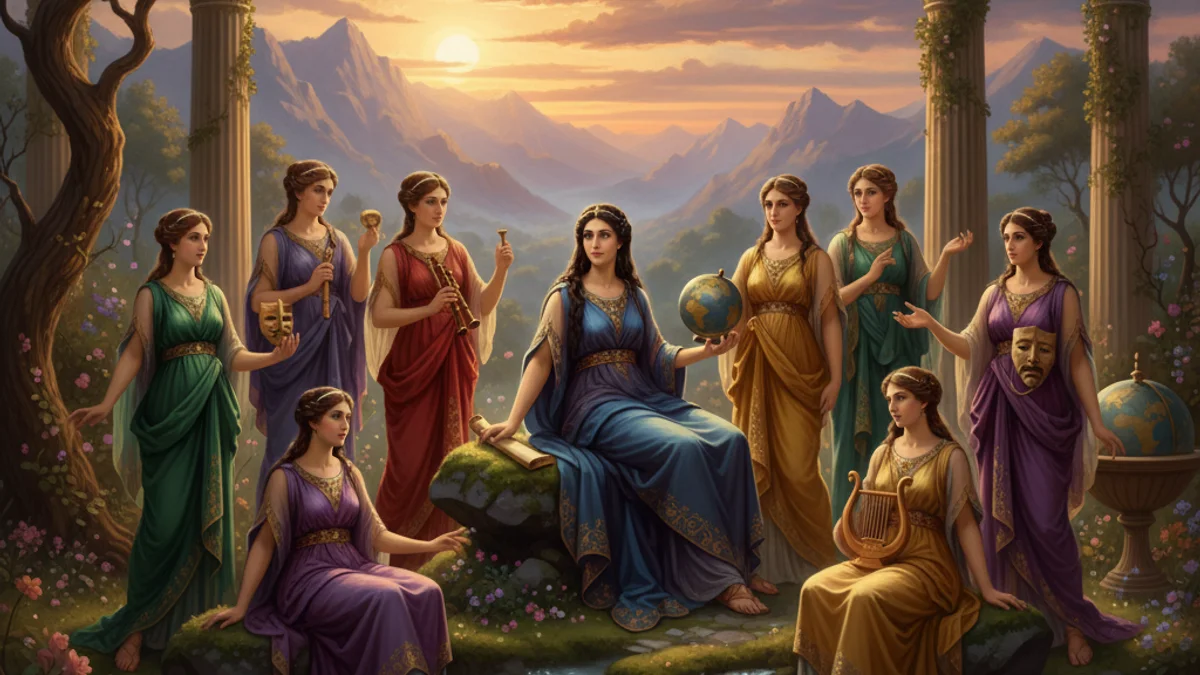
Before the world of mortals was filled with song and science, there was Mnemosyne, the Titaness of Memory and daughter of Uranus and Gaia. Zeus, the king of the gods, recognized that the triumphs of the Olympians and the beauty of existence would be lost to time without a way to record them. For nine consecutive nights, Zeus visited Mnemosyne in the mountains of Pieria. From their union, Mnemosyne gave birth to nine daughters: the Muses. These sisters—Calliope, Clio, Erato, Euterpe, Melpomene, Polyhymnia, Terpsichore, Thalia, and Urania—were born with hearts free from sorrow and voices that could charm the heavens. While Mnemosyne provided the foundation of memory and the preservation of the past, her daughters transformed that knowledge into the arts, music, dance, and history. Together, they ensured that the greatness of gods and men would never be forgotten, bridging the gap between divine wisdom and human expression.
The Moral
Memory is the essential foundation of all art, history, and wisdom; without it, creativity has no roots to grow.
“Memory is the mother of all wisdom and the sister of all art.”
Fun Fact
The English word 'museum' is derived from the Greek word 'Mouseion,' which means a place or temple dedicated to the Muses.
Frequently Asked Questions
What is the moral of Mnemosyne and the Muses?
The moral is that memory is the mother of all creativity and intellectual pursuit. It teaches that to create something new and meaningful, one must first possess the knowledge and records of the past.
Who was Mnemosyne in Greek mythology?
Mnemosyne was one of the original Titans, the daughter of Gaia and Uranus, and the personification of memory. She was considered one of the most powerful deities because she maintained the order of the universe through remembrance.
Who are the nine Muses?
The nine Muses are Calliope (epic poetry), Clio (history), Erato (lyric poetry), Euterpe (music), Melpomene (tragedy), Polyhymnia (hymns), Terpsichore (dance), Thalia (comedy), and Urania (astronomy).
Why did Zeus sleep with Mnemosyne for nine nights?
Zeus sought to create a way to celebrate the victory of the gods over the Titans and to preserve the beauty of the world. By joining with Memory for nine nights, he ensured each night produced a unique daughter to oversee a different branch of the arts.
Where did the Muses live?
The Muses were said to live on Mount Helicon or Mount Parnassus, near sacred springs like the Pierian spring. These locations were considered centers of poetic inspiration where the sisters would sing and dance for the gods.
What is the relationship between Mnemosyne and the Muses?
Mnemosyne is the mother of the Muses. This relationship symbolizes that all forms of artistic and scientific inspiration (the Muses) are born directly from the faculty of memory (Mnemosyne).