Story Summary
Discover the Greek myth of Iphigenia at Aulis, where King Agamemnon must choose between his daughter's life and the Trojan War. A tale of sacrifice and duty.
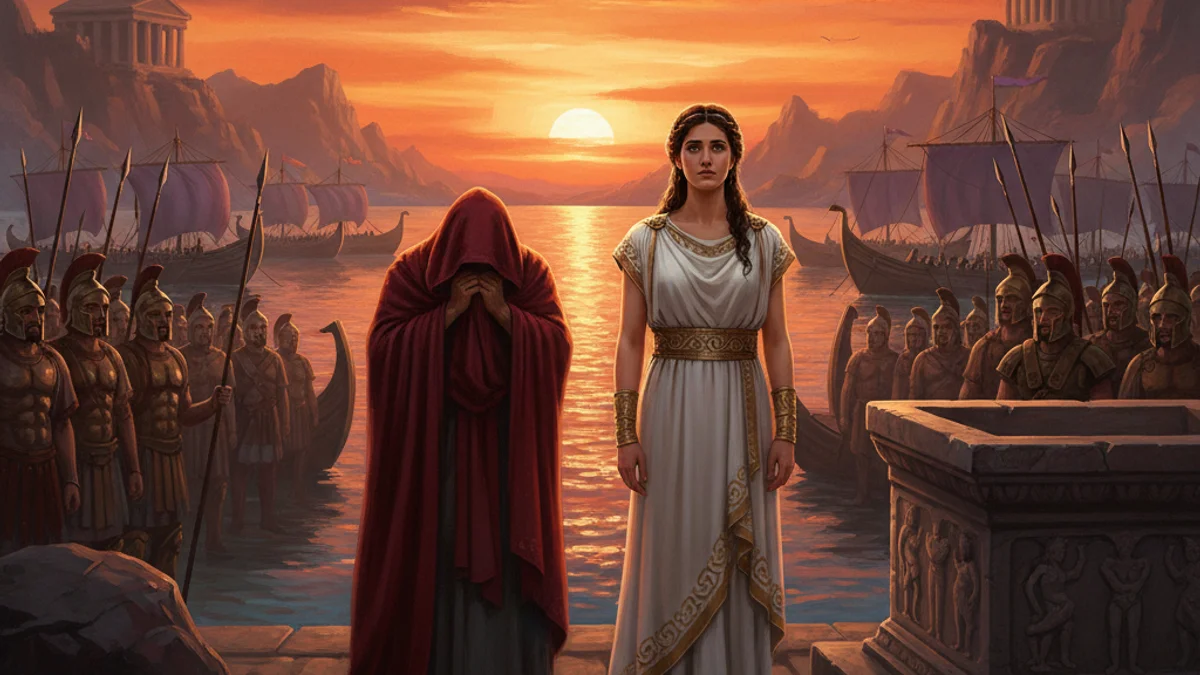
Agamemnon and the Greek fleet were stranded at Aulis, their sails hanging limp in a cursed calm. The seer Calchas revealed that the goddess Artemis, offended by Agamemnon’s hubris, demanded the sacrifice of his daughter, Iphigenia, before the winds would return. Desperate to lead his army to Troy, Agamemnon lured his daughter to the camp with the promise of marriage to Achilles. Upon arriving, Iphigenia discovered the cruel ruse. Despite the pleas of her mother Clytemnestra and the protection offered by Achilles, Iphigenia chose to die with dignity for the sake of Greece. At the moment of sacrifice, Artemis took pity on the girl’s courage. She replaced Iphigenia with a deer on the altar and spirited the princess away to Tauris, finally allowing the winds to blow toward Troy.
The Moral
True nobility is found in self-sacrifice for the greater good, yet the story warns that blind ambition can destroy the most sacred family bonds.
“I give my body to Greece; sacrifice it and sack Troy.”
Fun Fact
This myth served as the basis for one of Euripides' most famous tragedies, which was actually discovered and produced posthumously by his son or nephew.
Frequently Asked Questions
What is the moral of Iphigenia at Aulis?
The story explores the conflict between public duty and private love, suggesting that while sacrifice may be necessary for the state, it carries a devastating personal price. It also highlights the nobility of accepting one's fate with courage.
Why did Agamemnon have to sacrifice his daughter?
Agamemnon offended the goddess Artemis by killing a sacred deer and boasting of his hunting skill. To punish his hubris and test his resolve, Artemis stopped the winds, demanding Iphigenia's life in exchange for the fleet's passage to Troy.
Did Iphigenia actually die at Aulis?
In the most popular version by Euripides, Artemis intervenes at the last second, replacing Iphigenia with a deer and whisking her away to Tauris. However, earlier traditions and some tragedies imply the sacrifice was completed, leading to the curse on the House of Atreus.
How did Clytemnestra react to the sacrifice?
Clytemnestra was consumed by rage and grief over her husband's betrayal and the loss of her daughter. This act of cold ambition became her primary motivation for murdering Agamemnon when he eventually returned home from the war.
What role did Achilles play in the story?
Agamemnon used Achilles' name without his permission to lure Iphigenia to Aulis under the guise of a wedding. When Achilles learned of the lie, he tried to defend Iphigenia, but she ultimately stopped him to prevent further Greek infighting.
Why were the Greek ships stranded at Aulis?
The goddess Artemis withdrew the winds to prevent the Greeks from reaching Troy. Without a breeze to fill their sails, the massive fleet remained immobile, causing tension and desperation among the soldiers and their leaders.