Story Summary
Explore the haunting Slavic legend of Baba Yaga, the forest witch with a house on chicken legs. Discover how a brave girl survives the crone’s deadly trials.
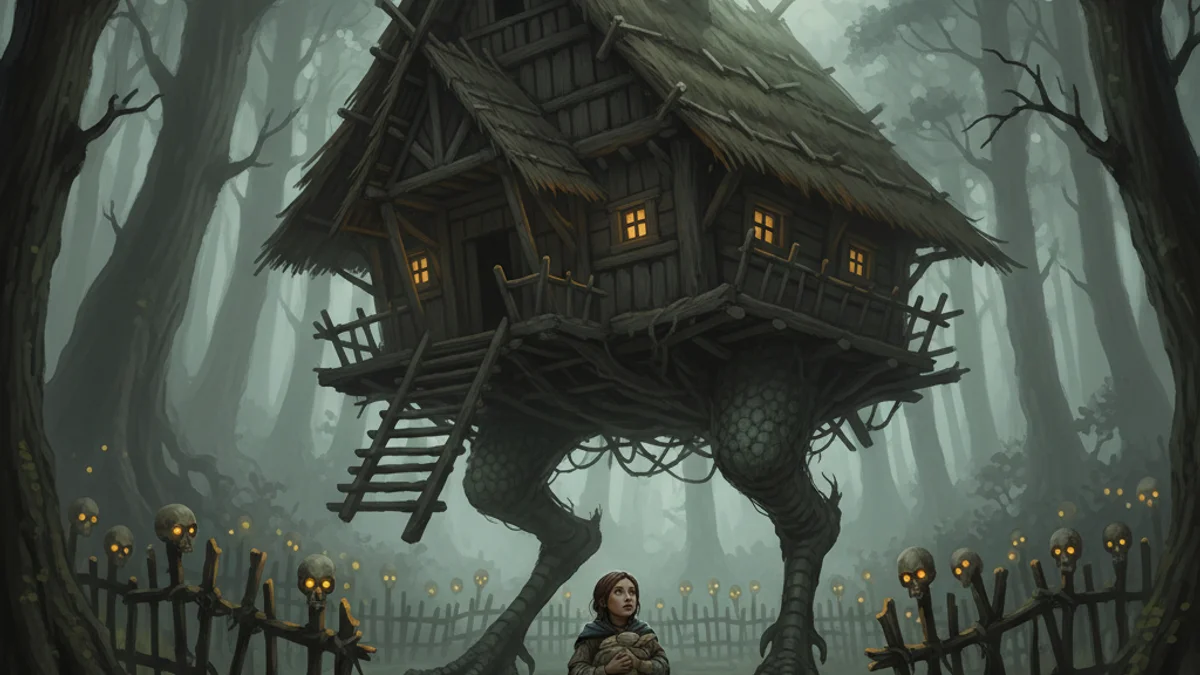
Deep in the birch forests of Russia lived Baba Yaga, an iron-toothed crone who rode through the sky in a giant mortar, steering with a pestle. Her hut stood on dancing chicken legs, surrounded by a fence of human bones. A young girl, sent by her cruel stepmother to fetch a light, arrived at the clearing trembling. Baba Yaga agreed to help, but only if the girl completed a series of impossible chores. Unlike others who perished, the girl showed kindness—feeding the hungry cat, oiling the creaking gate, and tying a ribbon on a birch tree. In return, the house's servants helped her flee when the witch intended to eat her. She escaped with a skull whose glowing eyes burned away the wickedness of her home, proving that resourcefulness and a pure heart can outwit even the darkest magic.
The Moral
Kindness and resourcefulness are powerful shields against cruelty. Treating all living things with respect can lead to help in the most unexpected places.
“I smell the scent of Russian blood!”
Fun Fact
The name 'Yaga' may stem from Old Church Slavonic words meaning 'horror' or 'chill,' perfectly reflecting her role as a personification of the dangerous forest.
Frequently Asked Questions
What is the moral of Baba Yaga?
The story teaches that kindness toward others, even the lowly, provides the help needed to overcome great obstacles. It also emphasizes the importance of resourcefulness and bravery when facing overwhelming odds.
Why does Baba Yaga live in a house on chicken legs?
In Slavic mythology, the chicken-legged hut represents the boundary between the world of the living and the dead. It allows the witch to remain elusive and mobile within her enchanted forest realm.
Is Baba Yaga evil or good?
Baba Yaga is an ambiguous figure who acts as both a villain and a wise donor. Her treatment of visitors usually depends on their manners, purity of heart, and ability to complete her tasks.
What does Baba Yaga use to travel?
Unlike Western witches on broomsticks, Baba Yaga travels in a giant stone mortar, steering it with a pestle. She uses a broom made of silver birch to sweep away her tracks behind her.
Who are the three horsemen of Baba Yaga?
She is often served by three riders: the White Horseman (Day), the Red Horseman (Sun), and the Black Horseman (Night). They signify her ancient power over the passage of time and nature.
What is the significance of the glowing skulls?
The glowing skulls on her fence serve as both a source of light and a macabre warning. In some versions, they possess the power to destroy the wicked, acting as a tool of karmic justice.