Story Summary
Explore the tragic Legend of the White Lady, a Chinese myth about a serpent spirit who falls in love with a mortal man, defying the laws of the heavens.
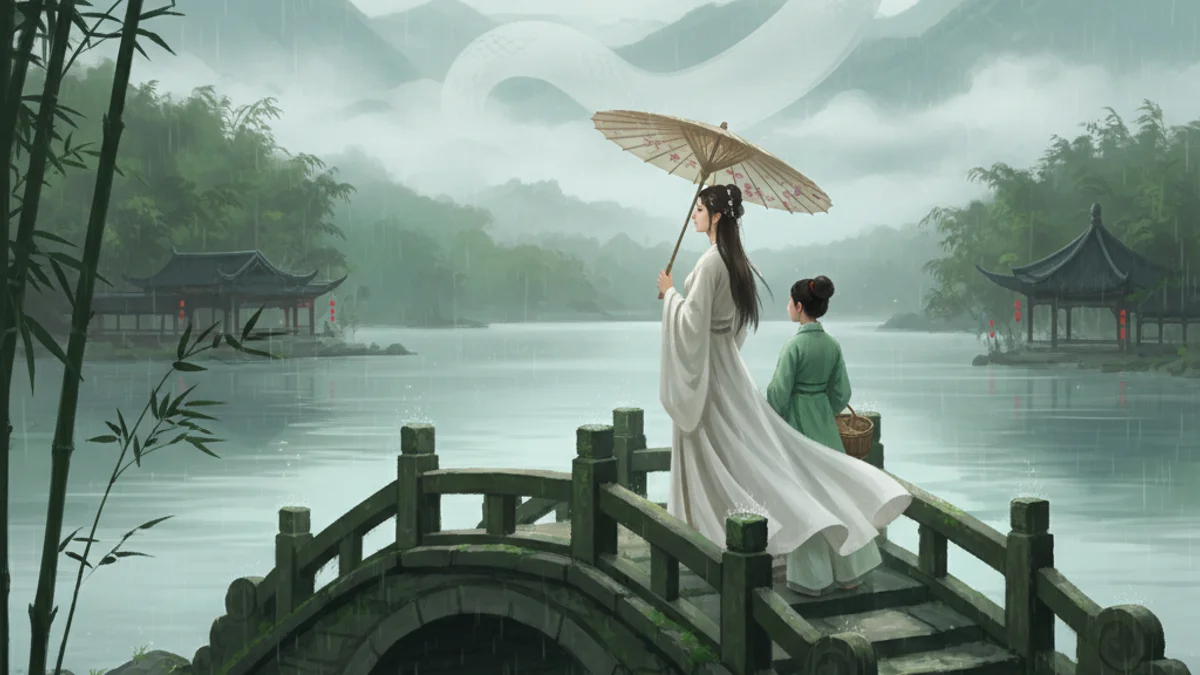
On the banks of the mist-shrouded West Lake, a powerful white snake spirit named Bai Suzhen achieved human form after a thousand years of meditation. Desiring to experience human love, she traveled to Hangzhou with her companion, a green snake named Xiaoqing. During a sudden rainstorm at the Broken Bridge, she met a kind herbalist named Xu Xian. The two fell deeply in love and married, opening a medicine shop together. However, their happiness was threatened by Fa Hai, a rigid Buddhist monk who believed spirits and humans should never mingle. During the Dragon Boat Festival, Fa Hai tricked Xu Xian into giving Bai Suzhen realgar wine, which forced her to reveal her true serpent form. Xu Xian died of fright, but Bai Suzhen risked her life to steal a magical herb from the heavens to revive him. Though Fa Hai eventually imprisoned Bai Suzhen beneath the Leifeng Pagoda to separate the lovers, their devotion became an eternal symbol of true love defying the boundaries of the mortal and spirit worlds.
The Moral
True love possesses the power to transcend physical forms and divine laws, though it requires honesty and courage to survive prejudice.
“Even a thousand years of cultivation cannot compare to one day of true love in the mortal world.”
Fun Fact
The Legend of the White Lady is considered one of China's Four Great Folktales and has been adapted into numerous Peking operas, films, and television series.
Frequently Asked Questions
What is the moral of The Legend of the White Lady?
The story teaches that true love is a powerful force that can transcend the boundaries of nature. It also highlights the tragedy that occurs when rigid societal or religious rules are used to destroy genuine human connection.
Who is the main antagonist in the Legend of the White Lady?
The antagonist is Fa Hai, a powerful Buddhist monk from the Jinshan Temple. He represents strict adherence to cosmic order and views the relationship between a spirit and a human as a violation of natural law.
Why did Bai Suzhen turn back into a snake?
She transformed because she consumed realgar wine during the Dragon Boat Festival. In Chinese folklore, realgar is believed to ward off pests and spirits, stripping them of their human disguises.
Is the Leifeng Pagoda a real place?
Yes, the Leifeng Pagoda is a real five-story tall tower on Sunset Hill south of the West Lake in Hangzhou. The original structure collapsed in 1924 but was rebuilt in 2002, remaining a major cultural landmark.
What happens to Xu Xian at the end of the story?
In many versions, after Bai Suzhen is imprisoned, a heartbroken Xu Xian becomes a monk to stay near the pagoda and pray for her. In some adaptations, they are eventually reunited by their son.
How does the Green Snake (Xiaoqing) help the White Lady?
Xiaoqing serves as Bai Suzhen's loyal sister and protector. She often uses her martial skills and magic to defend the couple against Fa Hai and is the one who eventually helps liberate Bai Suzhen in several versions of the tale.
Discussion (0)
Share your thoughts on this story
No comments yet. Be the first to share your thoughts!