Story Summary
Explore the spiritual beauty of Hafiz's Rose Garden Tales. This Persian fable of the nightingale and the rose reveals the profound nature of love and sacrifice.
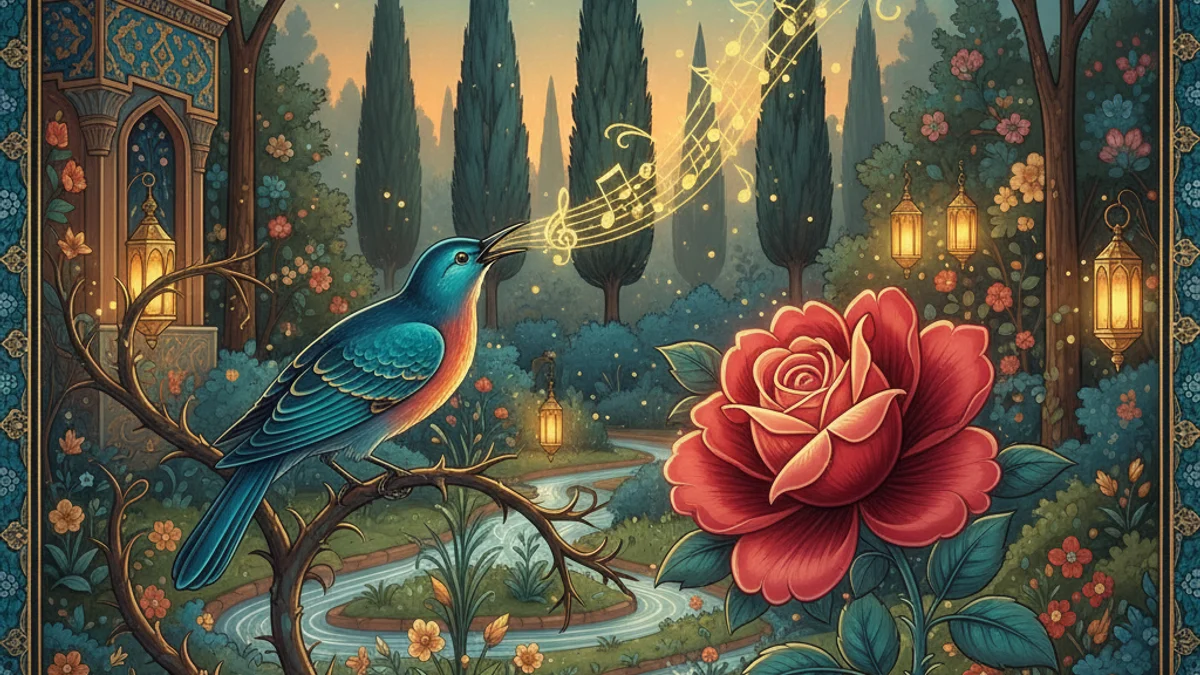
In a lush garden in Shiraz, a nightingale fell deeply in love with a silent, beautiful rose. Night after night, the bird sang his most heartbreaking melodies, hoping the flower would acknowledge his devotion. A thorn pierced his breast as he leaned closer, yet he did not stop singing. His blood stained the petals red, giving the rose its vibrant hue. Through his suffering, the nightingale learned that true love and divine beauty require total sacrifice. Hafiz observed this from the shadows, realizing that the poet is like the nightingale, and the truth is the rose—one must give everything to capture a single moment of perfection.
The Moral
True spiritual connection and beauty are found through selfless devotion and the willingness to endure hardship for the beloved.
“He who is in love does not fear the thorn, for the scent of the Rose is his only life.”
Fun Fact
Hafiz's 'Divan' is still used today for 'Fal-e Hafiz,' a tradition where people open his book to a random page to find guidance or a prophecy for their future.
Frequently Asked Questions
What is the moral of Hafiz's Rose Garden Tales?
The moral is that true love and spiritual enlightenment require selfless devotion and sacrifice. It teaches that beauty is often born from the endurance of pain and deep commitment.
Who was Hafiz of Shiraz?
Hafiz was a famous 14th-century Persian poet whose works are considered a pinnacle of Persian literature. His poems often explore themes of love, faith, and hypocrisy through mystical allegories.
What does the rose symbolize in Persian literature?
In Persian folklore and poetry, the rose typically symbolizes divine beauty, the ultimate truth, or the beloved. Its thorns represent the hardships one must face to reach spiritual heights.
Why is the nightingale significant in these tales?
The nightingale represents the lover or the seeker of truth. Its constant singing symbolizes the soul's longing for connection with the divine or the beloved.
Are these stories based on real events?
These stories are allegorical fables rather than historical accounts. They are designed to convey complex spiritual and philosophical ideas through simple, beautiful imagery.
How did Hafiz influence Persian culture?
Hafiz is so revered that his book is found in almost every Iranian home. His legacy continues through music, art, and the tradition of seeking guidance from his verses.