
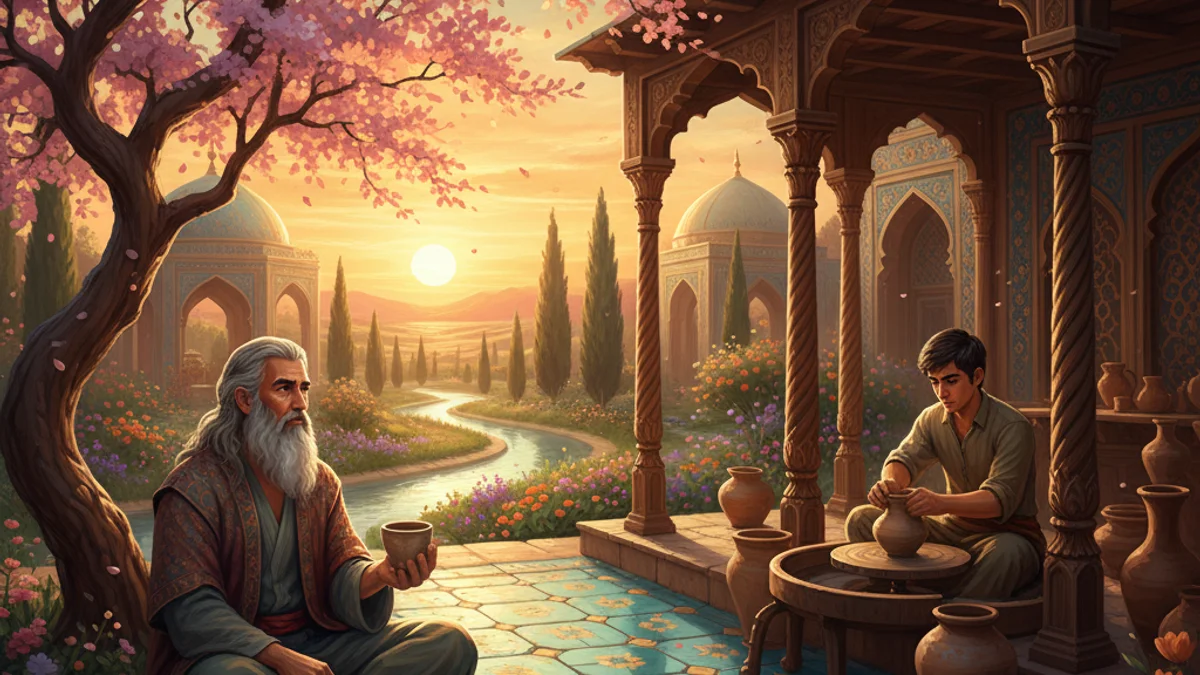
In the ancient city of Nishapur, the astronomer-poet Omar Khayyam sat within a walled garden where roses bloomed in heavy clusters. As he watched a potter at his wheel, he noticed how the craftsman handled the wet clay with both firmness and grace. To Omar’s eyes, the clay was more than earth; it was the dust of forgotten kings and ancient beauties, all returned to the soil. He contemplated the 'Moving Finger' of Fate, which writes the story of every life and never turns back to erase a single line. He saw that the world was a fleeting caravan, pausing only briefly at an oasis before vanishing into the desert. Realizing that tomorrow is a mystery and yesterday a memory, Omar chose to celebrate the eternal 'now.' He found that true wealth was not in gold, but in a simple loaf of bread, a jug of wine, and the company of a loved one beneath the shade of a tree. His verses became a testament to the beauty of the present, urging all who listen to cherish the breath they draw in this very moment.
Life is fleeting and fate is immutable, so one must find joy and meaning in the present moment rather than dwelling on the past or future.
Questions about this story
What is the moral of The Rubaiyat Stories?
The core moral is 'Carpe Diem' or 'seize the day.' It teaches that since time is fleeting and the future is unknown, we should appreciate the simple pleasures of the present moment.
Who was Omar Khayyam in history?
Omar Khayyam was a 11th-century Persian polymath, known as a brilliant mathematician, astronomer, and philosopher, as well as a poet. His scientific work on the calendar was incredibly accurate for its time.
What does the 'Moving Finger' symbolize?
The 'Moving Finger' represents the unstoppable passage of time and the permanence of fate. It suggests that once an event has happened, no amount of regret or prayer can change the past.
Why is the potter a recurring image in these stories?
The potter and the clay serve as a metaphor for the cycle of life and death. It suggests that the very earth we walk on is made of the people who came before us, emphasizing our connection to the past.
Advertisement



Good night.
