Story Summary
Discover the legend of Diogenes in His Barrel. Learn how the defiant philosopher chose a simple life and famously told Alexander the Great to move out of his sun.
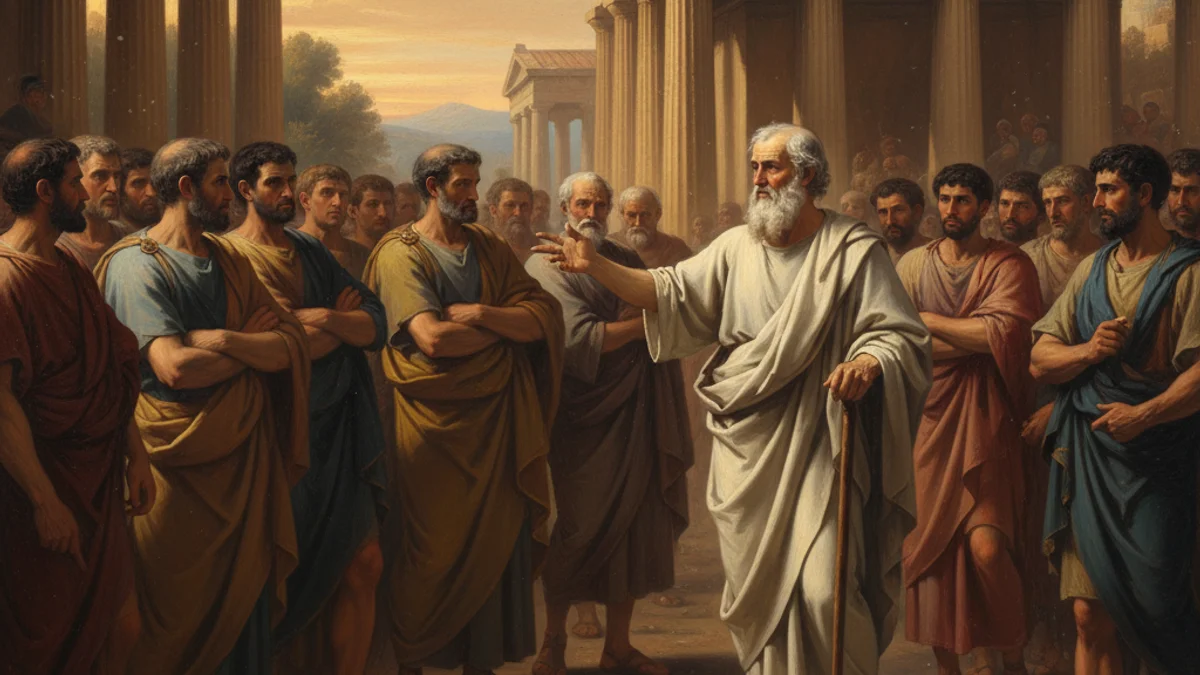
Diogenes of Sinope, the founder of Cynicism, lived a life of extreme simplicity in the streets of ancient Greece. Rejecting all material comforts, he made his home in a large ceramic storage jar—often referred to as a barrel—belonging to the Temple of Cybele. He walked the streets with a lantern in broad daylight, claiming to be searching for a single honest man. His reputation for biting wit and total indifference to social hierarchy reached the ears of Alexander the Great. When the mighty conqueror visited Corinth, he sought out the philosopher and found him basking in the sun. Alexander, impressed by the man's composure, stood over him and asked if there was any favor he could grant. Without looking up, Diogenes replied, 'Yes, stand out of my sunlight.' The king’s attendants were outraged, but Alexander silenced them, famously remarking, 'If I were not Alexander, I would wish to be Diogenes.'
The Moral
True freedom and contentment come from mastering one's own desires rather than accumulating power or wealth.
“Stand out of my sunlight.”
Fun Fact
Diogenes was known for his 'dog-like' lifestyle, and the word 'Cynic' actually derives from the Greek word for 'dog-like' (kynikos).
Frequently Asked Questions
What is the moral of Diogenes in His Barrel?
The moral is that true autonomy and happiness are found in self-sufficiency. By rejecting worldly status, Diogenes proved that even the most powerful king could not offer him anything more valuable than the sun.
Did Diogenes actually live in a wooden barrel?
In reality, Diogenes lived in a 'pithos,' which was a large ceramic storage jar used for wine or grain. The term 'barrel' became common in later translations and western storytelling.
Why did Diogenes carry a lantern during the day?
Diogenes walked through the crowded streets of Athens with a lit lantern, claiming he was searching for 'an honest man.' It was a provocative performance meant to criticize the hypocrisy of his fellow citizens.
What did Alexander the Great think of Diogenes?
Alexander deeply respected Diogenes' complete lack of fear and desire. He famously stated that if he could not be a world conqueror, he would want to live with the same freedom as the philosopher.
What philosophy did Diogenes follow?
Diogenes was a leading figure of Cynicism. This philosophy emphasized living in virtue and agreement with nature, rejecting conventional desires for wealth, power, and fame.
Where did the encounter between Alexander and Diogenes take place?
The legendary meeting is said to have taken place in Corinth, at the Craneum gymnasium, where Diogenes spent much of his time basking in the sun.
Discussion (0)
Share your thoughts on this story
No comments yet. Be the first to share your thoughts!