Story Summary
Experience the famous Taoist parable Zhuangzi and the Butterfly. This timeless story questions the nature of reality, identity, and the boundaries of dreams.
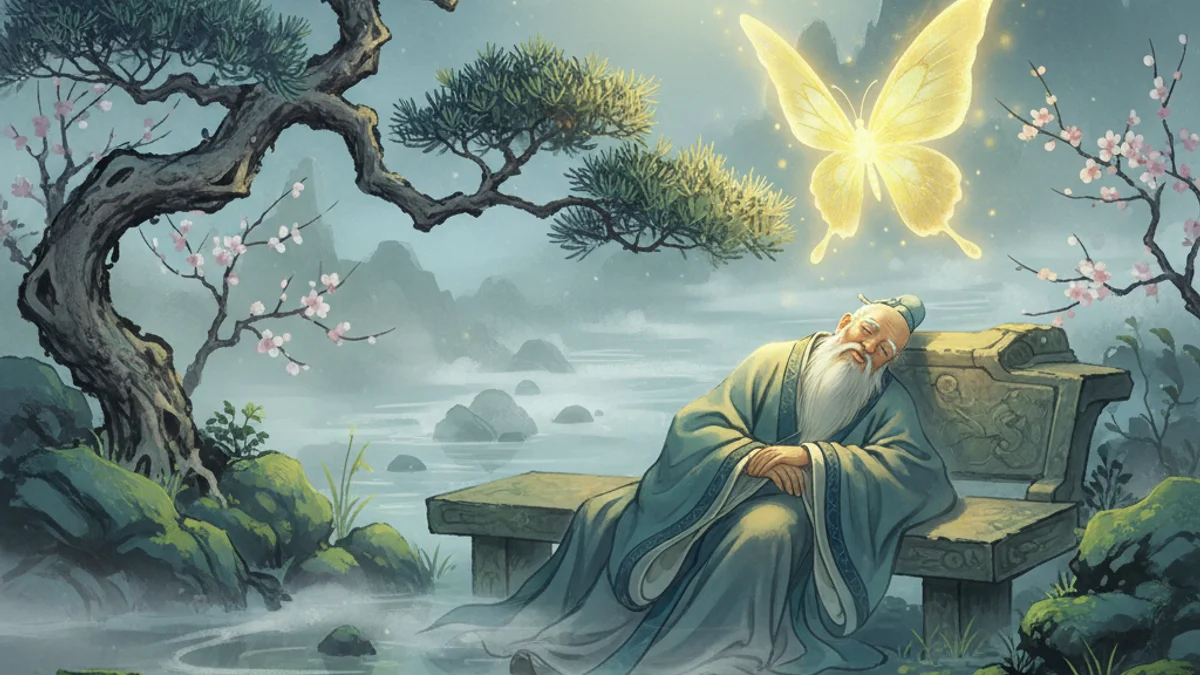
One afternoon, the philosopher Zhuangzi fell into a deep slumber and dreamed he was a butterfly. He flitted about joyfully, following his whims, completely unaware that he was Zhuangzi. He only knew his own happiness as a winged creature in the sun. Suddenly, he awoke and found himself lying there, unmistakably Zhuangzi again. But then he began to wonder: Was he a man who had dreamt he was a butterfly, or was he now a butterfly dreaming he was a man? He concluded that between the man and the butterfly, there must be a difference, yet this fluidity is what is called the transformation of things.
The Moral
The boundary between reality and dreams is fluid, suggesting that the self is part of a constantly changing and interconnected universe.
“Was I a man dreaming I was a butterfly, or am I now a butterfly dreaming I am a man?”
Fun Fact
This story is the most famous passage from the 'Zhuangzi' and is often cited in discussions comparing ancient Eastern philosophy to modern quantum physics and the nature of consciousness.
Frequently Asked Questions
What is the moral of Zhuangzi and the Butterfly?
The story teaches that reality is subjective and that the distinction between the 'self' and the 'other' is often an illusion. It encourages a perspective of unity and flow within the natural world.
Who was Zhuangzi?
Zhuangzi was a highly influential Chinese philosopher who lived around the 4th century BCE. He is credited with writing the 'Zhuangzi,' one of the foundational texts of Taoism.
What does the butterfly symbolize in the story?
The butterfly symbolizes freedom, transformation, and the fragility of the human ego. It represents a state of being that is spontaneous and perfectly in tune with the Tao.
What is the 'Transformation of Things' in Taoism?
It is the concept that all things in the universe are in a constant state of flux and change. This principle suggests that distinctions between different states of being are only temporary.
Is the butterfly dream a literal historical event?
While presented as a narrative, it is a philosophical metaphor. It is used to challenge the reader's certainty about their own existence and the permanence of perceived reality.
How has this story influenced modern culture?
It has inspired countless works of literature, film, and philosophy, particularly themes involving simulated reality and existentialism, similar to the core concepts in 'The Matrix'.
Discussion (0)
Share your thoughts on this story
No comments yet. Be the first to share your thoughts!