Story Summary
Discover the haunting legend of The Ghost of Oyuki, where a painter’s grief for his lost love created the iconic, footless image of the Japanese yūrei spirit.
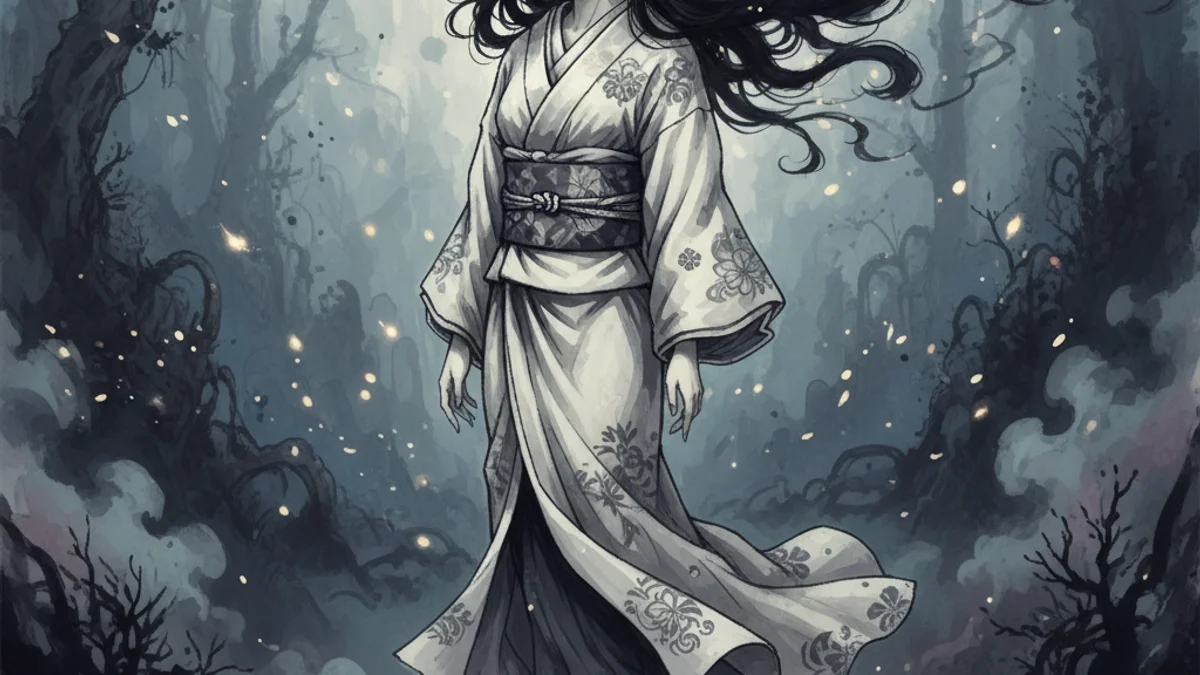
In the 18th century, the celebrated painter Maruyama Ōkyo lived in Kyoto, deeply in love with a beautiful young woman named Oyuki. Tragically, Oyuki fell ill and died, leaving Ōkyo in a state of profound, inconsolable grief. One night, as he lay in bed haunted by her memory, Oyuki appeared to him in a dream—or perhaps a vision. She was pale, her long black hair cascaded over her shoulders, and she wore the white robes of the dead. Most strikingly, her form faded into a misty void where her feet should have been. Moving with a sorrowful grace, she lingered before him before vanishing into the shadows. Driven by an urgent need to preserve her spirit, Ōkyo immediately seized his brushes and painted her exactly as he had seen her. This painting, known as 'The Ghost of Oyuki,' captured a beauty that transcended life and death. It became so famous that it set the standard for how ghosts are depicted in Japanese art for centuries to come, ensuring that while Oyuki’s body was gone, her image would haunt the world with its delicate, eternal sadness.
The Moral
Art and love possess the unique power to immortalize the spirit, allowing the essence of a person to endure long after their physical presence has faded.
“Through the stroke of a brush, a fleeting spirit became an eternal vision.”
Fun Fact
This single painting is credited with creating the 'standard' look for Japanese ghosts in kabuki theater, woodblock prints, and even modern J-Horror films like 'The Ring.'
Frequently Asked Questions
What is the moral of The Ghost of Oyuki?
The story suggests that deep love and artistic expression can bridge the gap between the living and the dead. It teaches us that while life is fleeting, the impact of a person can be preserved through memory and art.
Who was Maruyama Ōkyo?
Maruyama Ōkyo was a highly influential 18th-century Japanese artist who founded the Maruyama school of painting. He is famous for his 'sketch from nature' style, which combined Western realism with traditional Japanese techniques.
Why does the ghost of Oyuki have no feet?
According to the legend, Oyuki appeared to Ōkyo in a vision without feet, fading into a mist. This specific depiction became the definitive visual trope for ghosts (yūrei) in Japanese culture, which previously often had feet.
Is the painting of The Ghost of Oyuki real?
Yes, the painting exists and is officially titled 'Yūrei-zu.' It is traditionally kept at the Zenshō-an Temple in Tokyo and is sometimes put on public display during the ghost-story season in August.
What is a yūrei in Japanese folklore?
A yūrei is a Japanese ghost or spirit that has been kept from a peaceful afterlife due to intense emotions like grief, anger, or love. They are typically depicted in white burial kimonos with long, disheveled black hair.
How did Oyuki die?
Historical accounts and legends generally state that Oyuki was Ōkyo's mistress who died young from a sudden illness. Her untimely death caused the artist the immense grief that sparked his supernatural vision.