Story Summary
Explore the tragic tale of Hecuba's Grief. After the fall of Troy, a mother’s unbearable loss leads to a dark transformation and a quest for vengeance.
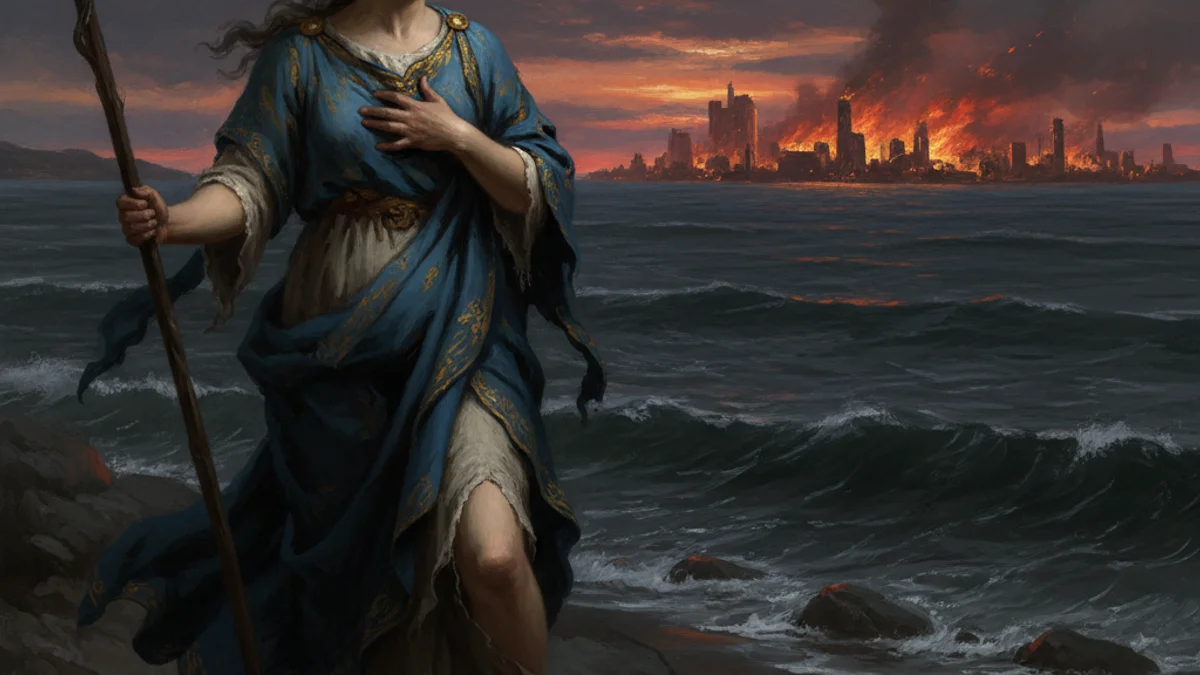
Queen Hecuba of Troy stood upon the smoking ruins of her kingdom, a witness to the total annihilation of her life. She had seen her husband, King Priam, slaughtered at the altar and her sons, including the noble Hector, fall to Greek blades. Taken as a captive, her heart broke further when her daughter Polyxena was sacrificed at Achilles' tomb. However, the final blow came when she discovered the lifeless body of her youngest son, Polydorus, washed ashore. He had been sent to King Polymestor for safety, but the King had murdered the boy for his gold. Driven past the brink of human endurance, Hecuba’s grief curdled into a cold, sharp vengeance. She lured Polymestor and his sons to her tent with the promise of hidden treasure. There, she and the captive Trojan women blinded the king and slew his children. As the Thracians pursued her with stones, Hecuba did not scream in pain; instead, her voice turned to a feral bark. Her body transformed into a black dog with fiery eyes, a living monument to a sorrow so profound it had outgrown its human vessel.
The Moral
Relentless tragedy and betrayal can strip away humanity, transforming even the noblest soul into a vessel of primal rage.
“A mother's sorrow is a sea without a shore, and vengeance is the only raft left to cling to.”
Fun Fact
Dante Alighieri features Hecuba's grief in his 'Inferno,' using her story as a prime example of how overwhelming rage and sorrow can drive a person to literal madness.
Frequently Asked Questions
What is the moral of Hecuba's Grief?
The story illustrates how extreme suffering and betrayal can consume a person's humanity. It serves as a grim reminder that grief, when coupled with injustice, can transform a noble spirit into something unrecognizable.
Who killed Hecuba's son Polydorus?
Polydorus was murdered by King Polymestor of Thrace, who had been entrusted with the boy's safety. Polymestor killed him to seize the Trojan gold and treasure sent along for his upbringing.
Why did Hecuba turn into a dog?
In Greek mythology, Hecuba's metamorphosis into a black dog represents her descent into feral madness and howling grief. It symbolizes the loss of her human capacity for reason after witnessing the death of almost all her children.
How did Hecuba take her revenge on Polymestor?
She lured Polymestor into her tent by promising him the location of hidden Trojan gold. Once he was vulnerable, she and other Trojan women blinded him and killed his young sons.
What happened to Hecuba after the Trojan War?
Hecuba was taken as a war prize by Odysseus. However, most accounts focus on her time in Thrace where she discovered her son's murder and underwent her tragic transformation.
What does the 'Cynosema' refer to?
The Cynosema, or 'Dog's Monument,' is a site in the Hellespont traditionally associated with Hecuba's transformation. It was a landmark used by ancient sailors to commemorate her tragic fate.