Story Summary
Discover the legend of Confucius and the Unicorn. When a divine Qilin appears in a time of chaos, the great philosopher sees a sign that his work is finished.
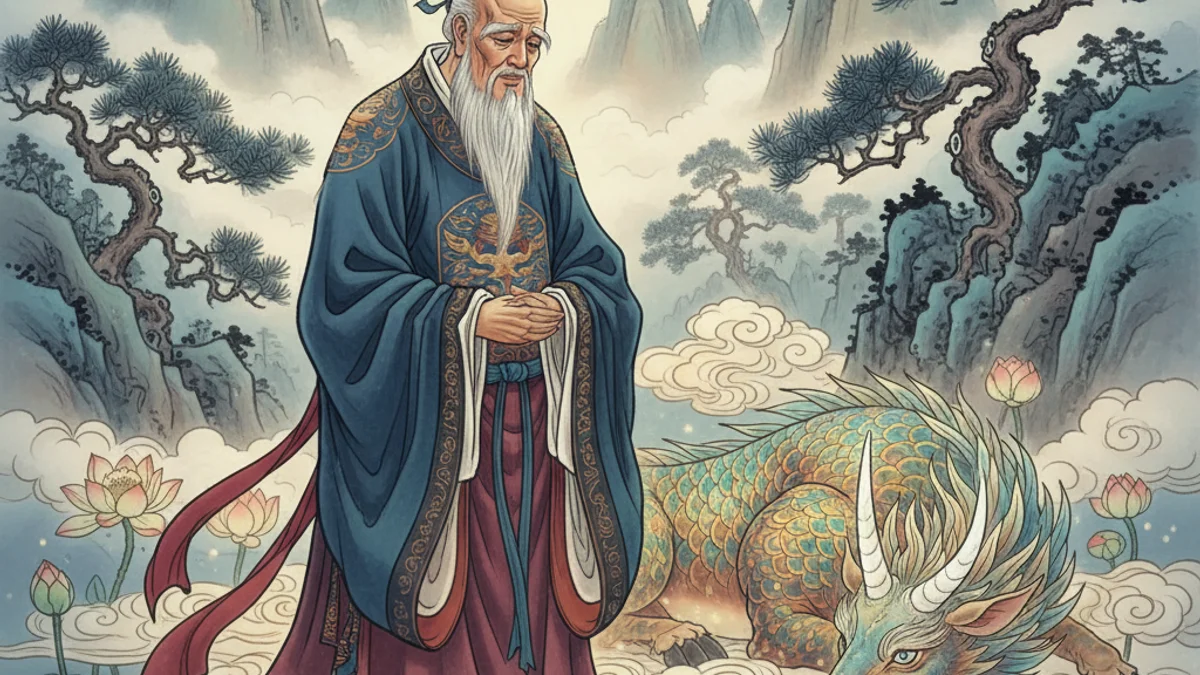
In the final years of his life, word reached Confucius that hunters in the state of Lu had captured a strange and wondrous beast. When the sage arrived, he gazed upon the creature and began to weep. It was a Qilin—the celestial Chinese unicorn—a divine being that appears only during the reign of a perfectly virtuous ruler. The hunters, not recognizing its sanctity, had wounded the creature. Confucius covered his face with his sleeves, lamenting that the Qilin had appeared in an age of chaos and violence where it could not be honored. To him, the broken beast was a mirror of his own life: a bearer of divine wisdom in a world that refused to listen. Recognizing this as a sign that his earthly mission was complete, Confucius laid down his brush, ceased writing the 'Spring and Autumn Annals,' and prepared for his journey into the beyond.
The Moral
The appearance of truth and virtue is a blessing, but if society is not ready to receive them, even the most divine gifts will be lost or misunderstood.
“For whom have you come? My path has come to an end.”
Fun Fact
Legend says that a Qilin also appeared to Confucius’s mother before his birth, presenting a jade tablet that prophesied he would be a 'king without a throne.'
Frequently Asked Questions
What is the moral of Confucius and the Unicorn?
The story teaches that virtue and wisdom require a receptive environment to flourish. It also reflects on the tragedy of being ahead of one's time, where profound truths are often neglected or harmed by the ignorant.
What does the Qilin symbolize in Chinese culture?
The Qilin is a mythical beast representing benevolence, prosperity, and the arrival of a Great Sage or an illustrious ruler. It is considered one of the four noble animals in Chinese mythology.
Why did Confucius cry when he saw the Qilin?
He wept because the Qilin's appearance during a time of political unrest meant it was out of place and destined for suffering. He viewed the capture of the divine beast as a sign that his own teachings would not be adopted in his lifetime.
Is the Qilin the same as a Western unicorn?
While often translated as 'unicorn' because of its single horn, the Qilin looks very different, often possessing the body of a deer, the scales of a dragon, and the tail of an ox. It is a symbol of peace rather than a wild forest creature.
How did this event end Confucius's career?
According to tradition, the capture of the Qilin was the final entry in Confucius's historical text, the 'Spring and Autumn Annals.' After this event, he stopped writing and focused on his internal spiritual preparations for death.
What is the historical significance of this story?
The story serves as a cultural 'bookend' to Confucius's life, linking his birth and death to the appearance of the Qilin. It emphasizes his status as an 'Uncrowned King' whose wisdom transcended his political failures.
Discussion (0)
Share your thoughts on this story
No comments yet. Be the first to share your thoughts!