Story Summary
Discover how Louis Braille Invents Reading for the blind. Follow the inspiring journey of a young boy who turned his tragedy into a global tactile language.
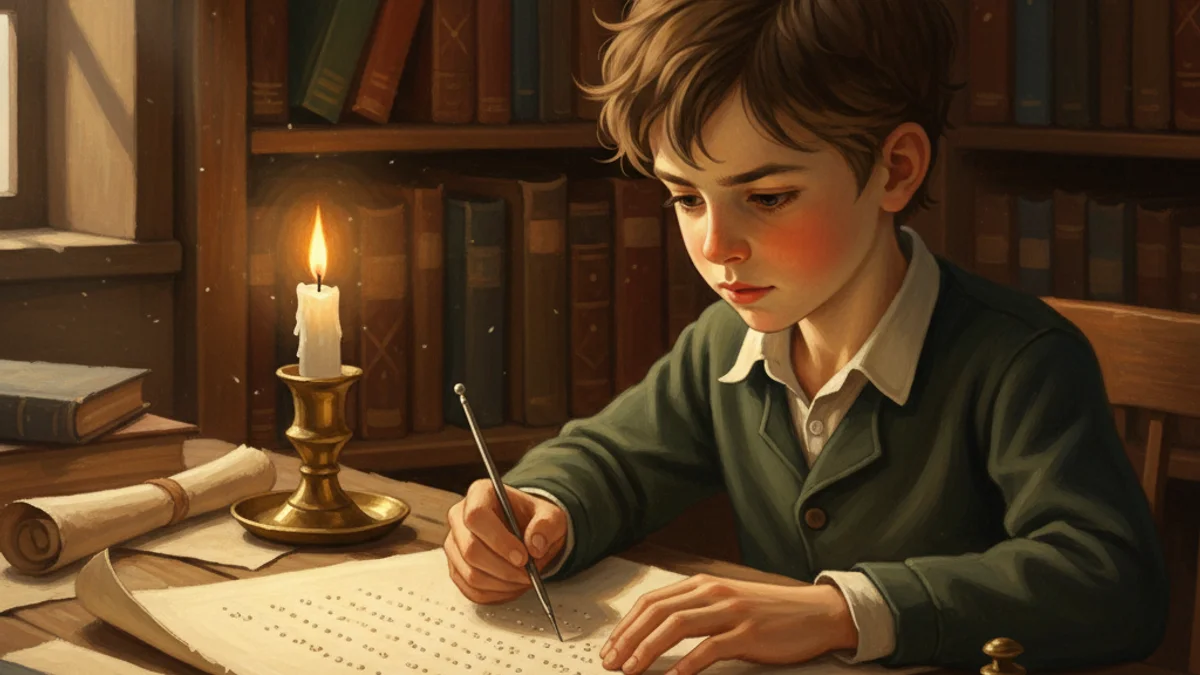
In the small French village of Coupvray, young Louis Braille played in his father's leather workshop. At age three, a tragic accident with a sharp awl left him blind in one eye, and an infection soon took the sight from the other. Despite his blindness, Louis was brilliant and won a scholarship to the Royal Institute for Blind Youth in Paris. There, he found a library of only fourteen books with oversized, embossed letters that were difficult to read and impossible to write. In 1821, a captain named Charles Barbier visited the school to demonstrate 'night writing,' a complex code of twelve dots used by soldiers. Louis realized the system was too bulky but saw its potential. For three years, the teenage boy spent his nights refining the code. He reduced the twelve dots to a six-dot cell that fit perfectly under a single fingertip. By 1824, at just fifteen years old, Louis had perfected the system that would open the world of literature and music to millions, proving that sight is not required to see the light of knowledge.
The Moral
Innovation born from personal adversity can create a legacy that empowers and liberates millions of others.
“Access to communication in the widest sense is access to knowledge.”
Fun Fact
Louis Braille also adapted his 6-dot system to include musical notation, allowing blind musicians to read and write complex scores just as sighted musicians do.
Frequently Asked Questions
What is the moral of Louis Braille Invents Reading?
The story teaches that determination and creativity can turn a personal disability into a revolutionary gift for humanity. It highlights how one person's persistence can break down barriers for everyone.
How did Louis Braille lose his sight?
Louis was accidentally blinded at age three while playing with an awl in his father's harness-making shop. An infection spread from the injured eye to the healthy one, leaving him completely blind.
What was 'night writing' and how did it help Louis?
Night writing was a tactile code invented by Charles Barbier for soldiers to communicate silently in the dark. Louis used it as a foundation, simplifying its complex 12-dot system into his efficient 6-dot cell.
How old was Louis Braille when he invented his system?
Louis was incredibly young when he made his breakthrough; he began working on the code at age 12 and completed the first version of his system by age 15.
Why was the Braille system better than previous methods?
Earlier methods used embossed versions of standard letters, which were bulky and slow to read. Louis's system used small dot patterns that fit under a fingertip, allowing for much faster reading and easy writing.
Was the Braille system popular during Louis's lifetime?
Unfortunately, it was not widely adopted by the public or his own school during his lifetime. It only became the global standard for the blind several years after his death in 1852.
Discussion (0)
Share your thoughts on this story
No comments yet. Be the first to share your thoughts!