Story Summary
Explore the tragic legend of Tristan and Iseult, a tale of forbidden love, magical potions, and the conflict between loyalty and passion in Arthurian lore.
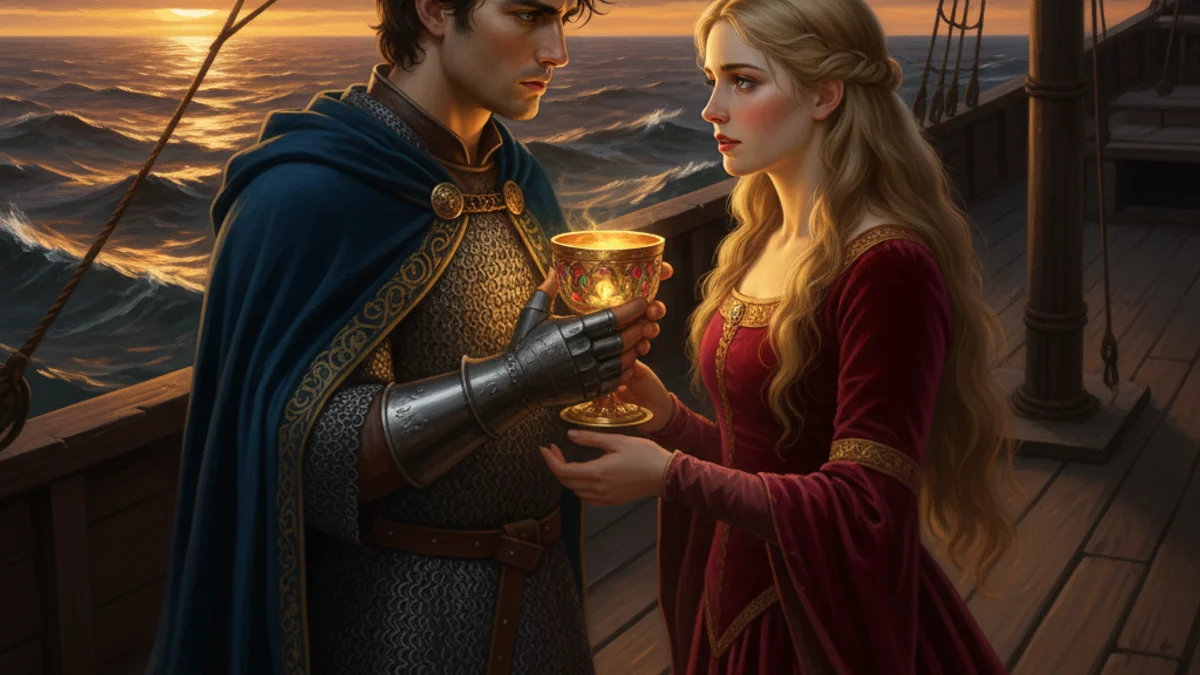
Tristan, a brave Cornish knight and nephew to King Mark, was sent to Ireland to fetch the beautiful Iseult to be his uncle’s bride. During the return voyage, the pair unknowingly drank a magical love potion intended for the King and his new Queen. This draught bound their souls in an eternal, inescapable passion that defied their loyalty to the crown. Though Iseult married King Mark, her heart remained with Tristan, leading to a series of secret encounters and Narrow escapes from discovery. Their forbidden romance eventually tore the kingdom apart, resulting in Tristan's banishment. In the twilight of his life, wounded and dying in a distant land, Tristan sent for Iseult, his only hope for healing. A misunderstanding regarding the color of a ship's sail led Tristan to believe Iseult had refused him; he died of despair moments before she arrived. Finding her lover dead, Iseult succumbed to a broken heart, their love finally united in the silence of death.
The Moral
True love is a powerful and often uncontrollable force that can transcend social duty, yet it carries the weight of profound sacrifice and tragedy.
“My life is yours, and your death is mine; for we are one in the draught of love.”
Fun Fact
This legend served as a primary inspiration for Richard Wagner’s famous opera, 'Tristan und Isolde,' which revolutionized Western music through its use of chromaticism.
Frequently Asked Questions
What is the moral of Tristan and Iseult?
The moral highlights the overwhelming power of love as a destiny that cannot be fought. It suggests that while love is beautiful, it often demands impossible sacrifices when it conflicts with social and moral duties.
How does the love potion affect the story?
The potion serves as the catalyst for the tragedy, removing the lovers' agency and making their passion a magical inevitability. It creates the central conflict between their genuine feelings and their obligations to King Mark.
Is Tristan a Knight of the Round Table?
Yes, in most later versions of the Arthurian cycle, Tristan is depicted as one of the most skilled Knights of the Round Table. His exploits often parallel those of Lancelot, another knight caught in a forbidden love.
How did Tristan and Iseult die?
Tristan died from a combination of a poisoned wound and the grief of believing Iseult had abandoned him. Iseult died shortly after from a broken heart upon finding Tristan's lifeless body.
Who is the primary antagonist in the legend?
While King Mark is the rival for Iseult's affection, he is often portrayed as a sympathetic figure. The true 'antagonists' are usually the societal expectations and the sailors or courtiers who betray the lovers' secrets.
What is the significance of the black and white sails?
The sails were a signal: white if Iseult was on the ship coming to save Tristan, and black if she was not. Tristan’s jealous wife lied, saying the sails were black, which caused his final despair.
Discussion (0)
Share your thoughts on this story
No comments yet. Be the first to share your thoughts!