Story Summary
Experience the redemption of Oscar Wilde's The Selfish Giant. Learn how a cold-hearted giant transforms his garden and soul through the power of a child's love.
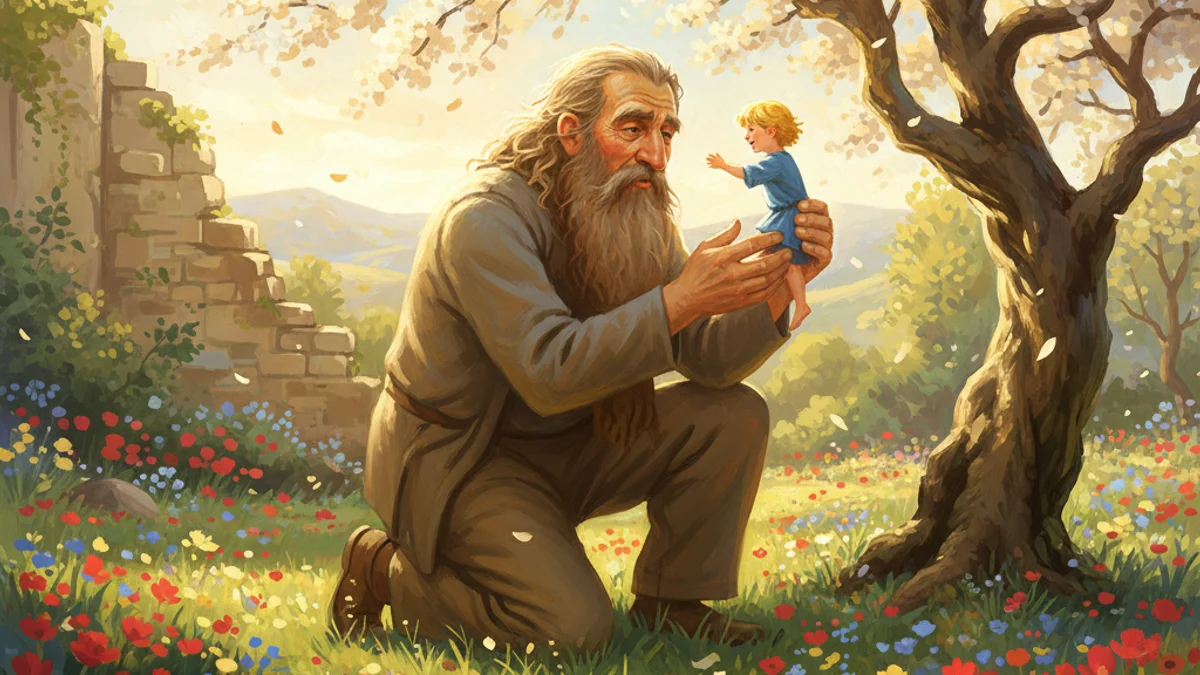
Every afternoon, children played in a beautiful garden belonging to a Giant who had been away for seven years. When the Giant returned, he was furious to find them there. 'My own garden is my own garden,' he growled, and he built a high wall around it, putting up a sign: 'TRESPASSERS WILL BE PROSECUTED.' He was a very selfish Giant. Spring came to the rest of the country, but in the Giant’s garden, it remained Winter. The Snow, Frost, North Wind, and Hail moved in, delighted that the Spring had forgotten this one place. One morning, the Giant heard a linnet singing and smelled a delicious perfume. He looked out to see a wonderful sight: the children had crept in through a small hole in the wall. They were sitting in the branches of the trees, and the trees had broken into blossom. Only in one corner was it still Winter. A tiny boy stood there, unable to reach the branches of a tree covered in frost. The Giant’s heart melted. 'How selfish I have been!' he said. He stole downstairs and gently lifted the boy into the tree, which instantly bloomed. The Giant knocked down the wall and declared the garden open to the children forever. Years passed, and the Giant grew old. One winter morning, he saw the same little boy standing under a tree white with blossoms. The boy had wounds on his hands and feet. 'These are the wounds of Love,' the boy told the Giant. 'You let me play once in your garden; today you shall come with me to my garden, which is Paradise.' When the children ran in that afternoon, they found the Giant lying dead under the tree, all covered with white blossoms.
The Moral
True happiness and redemption are found through kindness, generosity, and sharing one's blessings with others.
“I have many beautiful flowers, but the children are the most beautiful flowers of all.”
Fun Fact
Oscar Wilde wrote this story for his two sons and published it in 1888 as part of 'The Happy Prince and Other Tales,' a collection intended to teach children about sacrifice and empathy.
Frequently Asked Questions
What is the moral of The Selfish Giant?
The moral is that selfishness leads to isolation and spiritual winter, while generosity and love bring joy and eternal life. It teaches that what we share with others returns to us in the form of happiness.
Who is the little boy in The Selfish Giant?
The little boy is a Christ-figure, as indicated by the 'wounds of love' on his hands and feet at the end of the story. He represents divine grace and invites the Giant to Paradise as a reward for his kindness.
Why would Spring not enter the Giant's garden?
Spring refused to enter because the garden had become a place of selfishness and exclusion. Nature reacted to the Giant's cold heart by keeping the garden in a state of perpetual winter until the children returned.
How does the Giant's character change?
The Giant transforms from a mean, possessive recluse into a compassionate and loving figure. This change is triggered when he sees the suffering of the smallest child and realizes that his own actions caused the eternal winter.
What does the garden symbolize in the story?
The garden symbolizes the Giant's soul and the state of his heart. When he is selfish, the garden is cold and barren; when he opens it to others, it becomes a beautiful, life-giving paradise.
What happens at the end of The Selfish Giant?
At the end of the story, the Giant dies peacefully and is taken to Paradise by the little boy he once helped. His body is found covered in white blossoms, symbolizing his purity and redemption.
Discussion (0)
Share your thoughts on this story
No comments yet. Be the first to share your thoughts!