Story Summary
Read the Panchatantra tale of The Blue Jackal, a clever trickster who dyes his fur to rule the forest until a single howl reveals his true identity and nature.
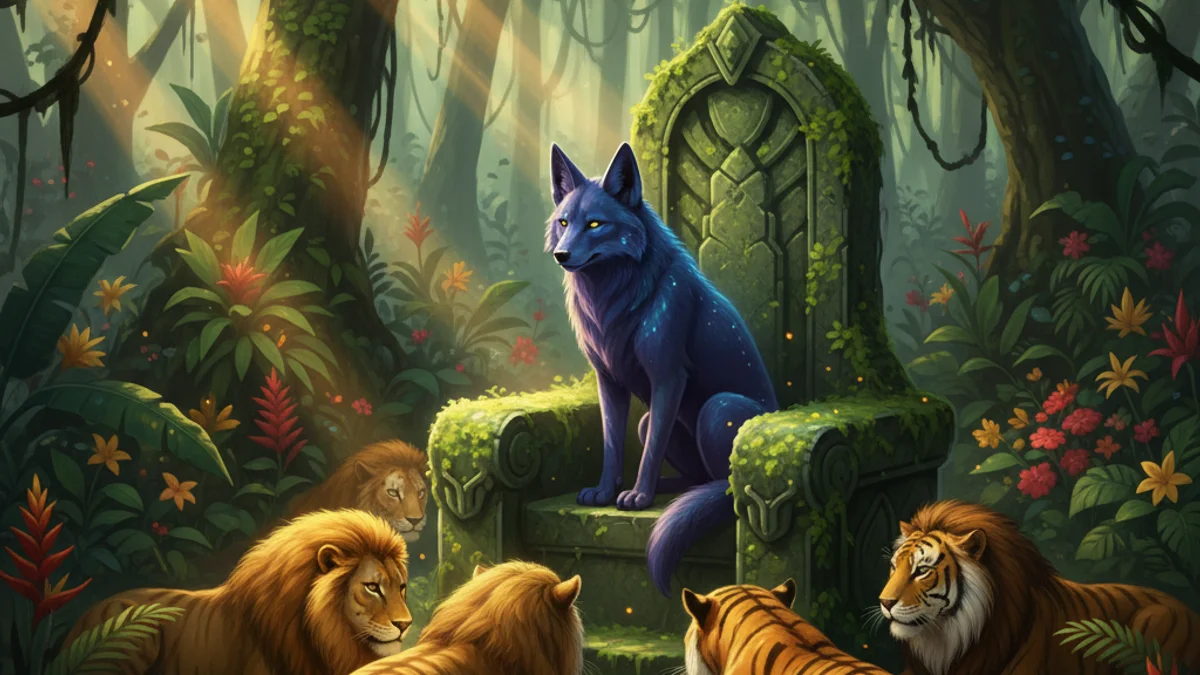
Chandaraka was a hungry jackal who wandered into a nearby village in search of food. Chased by a pack of fierce dogs, he jumped into a large vat of indigo dye at a dyer’s house to hide. When he emerged, he was blue from head to tail. Returning to the forest, the other animals were terrified of this strange, celestial-looking creature. Realizing his advantage, Chandaraka proclaimed, 'The gods have anointed me as your king to protect you.' Fearful and impressed, the lion, tiger, and elephant became his servants. Chandaraka enjoyed his new life of luxury, but he made sure to banish all other jackals from his sight, fearing they would recognize him. One evening, a pack of jackals in the distance began their rhythmic howling. Instinct took over, and Chandaraka threw back his head and joined in with a loud 'Howl! Howl!' The animals immediately realized their king was merely a common jackal. Enraged by his deception, they chased the impostor out of the forest.
The Moral
One's true nature cannot be hidden forever; eventually, the mask falls and the truth is revealed.
“Instinct is stronger than any disguise.”
Fun Fact
The Panchatantra, which includes this story, is one of the oldest collections of fables in the world, dating back to roughly 200 BCE, and has been translated into over 50 languages.
Frequently Asked Questions
What is the moral of The Blue Jackal?
The moral is that your true identity cannot be hidden by external appearances for long. Deception eventually leads to exposure, as one's inherent nature will always surface in the end.
How did the jackal become blue?
While trying to escape a pack of village dogs, the jackal jumped into a dyer's vat filled with indigo blue dye. The dye was so strong that his entire coat was permanently stained blue.
How was the Blue Jackal finally exposed?
He was exposed when he heard a pack of nearby jackals howling. Overcome by his natural instincts, he forgot his disguise and began howling along with them, revealing his true species to the other animals.
Who wrote the story of The Blue Jackal?
The story is part of the Panchatantra, an ancient Indian collection of interrelated animal fables in Sanskrit verse and prose, traditionally attributed to the scholar Vishnu Sharma.
Why did the jackal banish the other jackals?
He banished them because he feared that his own kind would be the first to recognize his voice and behavior, thereby exposing his fraudulent claim to divinity and kingship.
What does the indigo color symbolize in the story?
The indigo color symbolizes a false exterior or an artificial status. It represents the deceptive 'mask' people wear to gain power or respect that they have not earned through merit.
Discussion (0)
Share your thoughts on this story
No comments yet. Be the first to share your thoughts!