
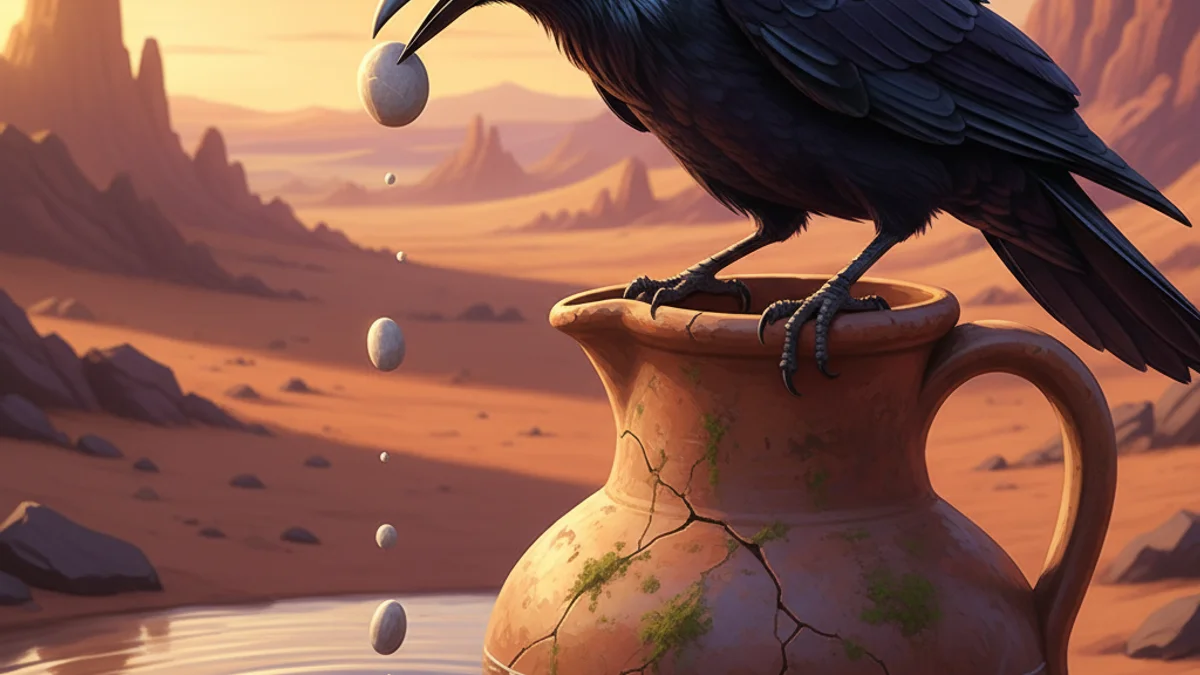
It had not rained for many weeks, and a crow was almost dying of thirst. She flew from place to place looking for water.
At last she saw a tall pitcher standing in a garden. She flew down and looked inside. There was a little water at the bottom, but her beak could not reach it.
She tried to tip the pitcher over, but it was far too heavy. She tried to break it, but it was far too strong.
The crow sat and thought. Then she noticed some small pebbles on the ground.
She picked up a pebble in her beak and dropped it into the pitcher. Plop. She dropped in another. Plop. One by one, she dropped in the pebbles, and little by little the water rose.
At last the water came high enough. The crow took a long, cool drink and flew away.
A little thinking can solve a big problem.
Discussion questions
- What did the Crow try first, and why did it fail?
- How did the Crow solve the problem?
- What can we do when our first idea does not work?
Questions about this fable
What is the moral of The Crow and the Pitcher?
The primary moral is that 'necessity is the mother of invention.' It teaches that persistence and clever thinking can solve problems that physical strength cannot.
Can real crows actually perform the task in the story?
Yes, scientific studies have shown that corvids, such as crows and ravens, possess the cognitive ability to understand water displacement. They have successfully completed similar tasks in laboratory settings.
Who is the author of The Crow and the Pitcher?
The story is attributed to Aesop, a storyteller believed to have lived in ancient Greece. His fables were originally passed down through oral tradition before being recorded.
What does the pitcher represent in the fable?
The pitcher represents an insurmountable obstacle or a challenge that requires more than just brute force. It symbolizes the limitations of physical reach versus the power of the mind.
Advertisement


Good night.
Tomorrow night: The Fox and the Crane
