
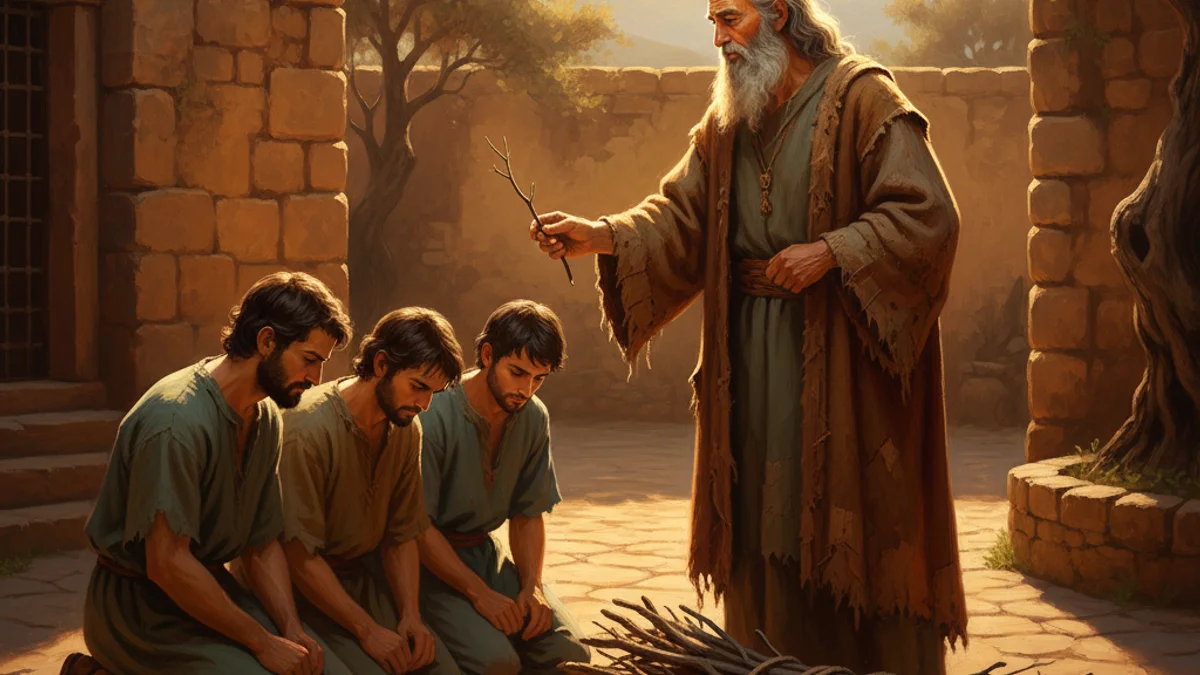
An aging father was deeply grieved by the constant quarreling among his sons. No matter how much he urged them to find harmony, they continued to bicker. One day, he called them together and presented a bundle of sticks tied firmly with cord. 'Break this bundle,' he commanded. Each son stepped forward and strained with all his might, but the bundle remained whole and unyielding. The father then untied the cord and handed a single stick to each of his sons. 'Now, break these,' he said. The sticks snapped instantly with the slightest effort. Looking at his sons, the father said, 'You are like these sticks. Individually, you are as easily broken as a single twig, but standing together in unity, you are as strong as the bundle.'
There is strength in unity, while discord and division lead to weakness and defeat.
Questions about this story
What is the moral of The Bundle of Sticks?
The moral is that unity is strength. When people work together and support one another, they become far more resilient and harder to overcome than they would be standing alone.
Who wrote The Bundle of Sticks?
This fable is traditionally attributed to Aesop, the legendary Greek storyteller. However, similar themes of collective strength appear in various ancient cultures, including Scythian and Persian folklore.
Why couldn't the sons break the bundle of sticks?
The sticks were bound tightly together, allowing them to share the pressure and tension applied by the sons. This collective resistance made the bundle too thick and sturdy for any one man to snap.
What do the sticks symbolize in the story?
The sticks symbolize the individual members of a family or group. When tied together, they represent a unified front; when separated, they represent the vulnerability of individuals who lack mutual support.
Advertisement
Read it in another language
- حزمة العصي · العربية
- Das Bündel Stöcke · Deutsch
- El Haz de Palos. · Español
- دسته چوبها · فارسی
- Le Fagot de Bâtons. · Français
- लकड़ियों का गट्ठर। · हिन्दी
- Il Fascio di Bastoni. · Italiano
- O Feixe de Varas. · Português
- Веник из прутьев. · Русский
- కర్రల కట్ట. · తెలుగు
- Ang Bigkis ng mga Patpat. · Tagalog
- В'язка паличок. · Українська
- 一捆木棍。 · 中文


Good night.
