
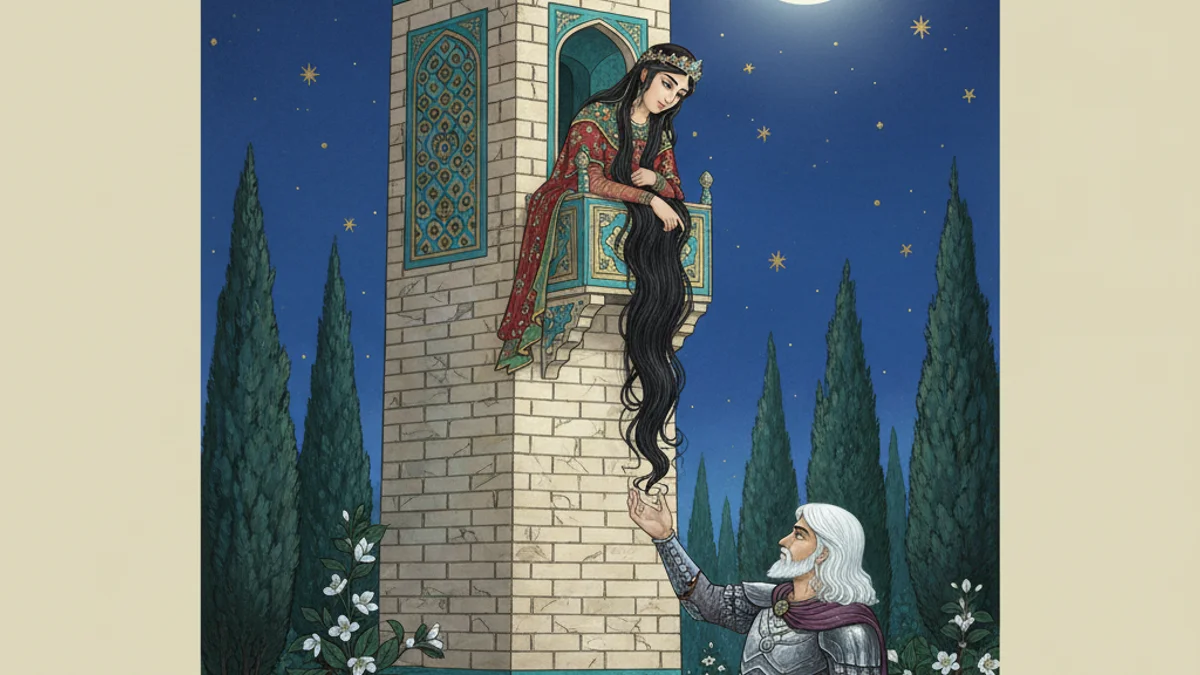
Zal, the white-haired hero who had been raised by the mythical Simurgh bird, heard tales of the incomparable beauty and wisdom of Rudabeh, the princess of Kabul. Despite the political enmity between their families—as Rudabeh was a descendant of the serpent-king Zahhak—Zal traveled to her father's kingdom. The two met in secret at Rudabeh’s palace tower. In a gesture of devotion, she offered her long tresses as a rope for him to climb, though the noble Zal instead used a cord to reach her balcony. Their love was immediate and profound, but it faced fierce opposition from the Persian Shah and Zal's father, Sam, who feared the union of such disparate lineages. However, after court astrologers prophesied that their union would produce the greatest champion the world had ever known, the opposition crumbled. Zal and Rudabeh were married in a grand ceremony, eventually becoming the parents of the legendary hero Rostam.
True love and destiny can bridge even the deepest ancestral divides and turn old enmities into a glorious future.
Questions about this story
What is the moral of Zal and Rudabeh?
The story teaches that love has the power to overcome political prejudice and ancestral feuds. It emphasizes that character and destiny are more important than one's family tree or physical differences.
Why was Zal born with white hair?
Zal was born with albinism, which gave him white hair from birth. His father, Sam, initially feared it was a demonic sign and abandoned him, though he was later rescued and raised by the mythical Simurgh.
Who is the son of Zal and Rudabeh?
They are the parents of Rostam, the most famous and powerful hero in Persian mythology. Rostam's birth was facilitated by the Simurgh using ancient medical knowledge.
Why was their marriage forbidden?
Rudabeh was a descendant of the villainous King Zahhak, the serpent-shouldered tyrant. The Persian king feared that any offspring from her line would inherit Zahhak's evil nature and threaten the throne.
Advertisement
Good night.
