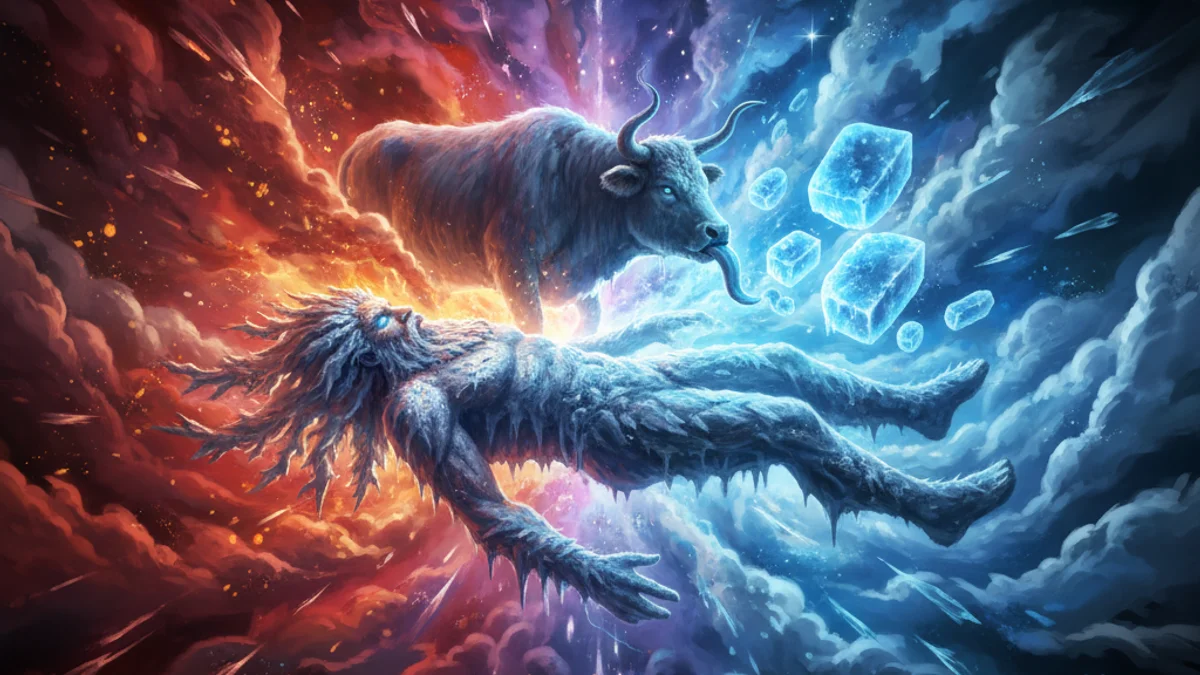
Before the earth was formed, there was only Ginnungagap, a vast and howling void. To the north lay the frozen mists of Niflheim, and to the south, the scorching fires of Muspelheim. Where the heat met the frost, the ice began to melt, and from these life-giving drops emerged Ymir, the first of the frost giants. Alongside him came Audhumla, a primordial cow whose milk nourished him. As Ymir slept, he sweated, and from his limbs more giants were born. Meanwhile, Audhumla licked the salty ice blocks, eventually revealing Buri, the ancestor of the gods. Generations later, Buri’s grandson Odin and his brothers Vili and Ve rose up against the chaotic Ymir. They slew the giant, and from his massive corpse, they fashioned the world: his flesh became the earth, his blood the vast oceans, his bones the mountains, and his skull the dome of the sky. Thus, the death of the first being gave life to the universe.
The story of Ymir illustrates that creation often requires sacrifice and that order is frequently born from the transformation of chaos.
Questions about this story
What is the moral of Ymir the First Giant?
The moral is that creation and progress often come at the cost of sacrifice. It suggests that the world we inhabit is built upon the foundations of those who came before us.
Who killed Ymir in Norse mythology?
Ymir was killed by Odin and his two brothers, Vili and Ve. They were the sons of Borr and the first of the Aesir gods to challenge the frost giants.
How was the world created from Ymir's body?
Odin and his brothers used Ymir's flesh for the earth, his unbroken bones for mountains, his blood for the sea, and his skull for the sky.
What was the role of the cow Audhumla?
Audhumla provided nourishment for Ymir with her milk and uncovered the first god, Buri, by licking the salty frost blocks of Ginnungagap.
Advertisement
Good night.
