
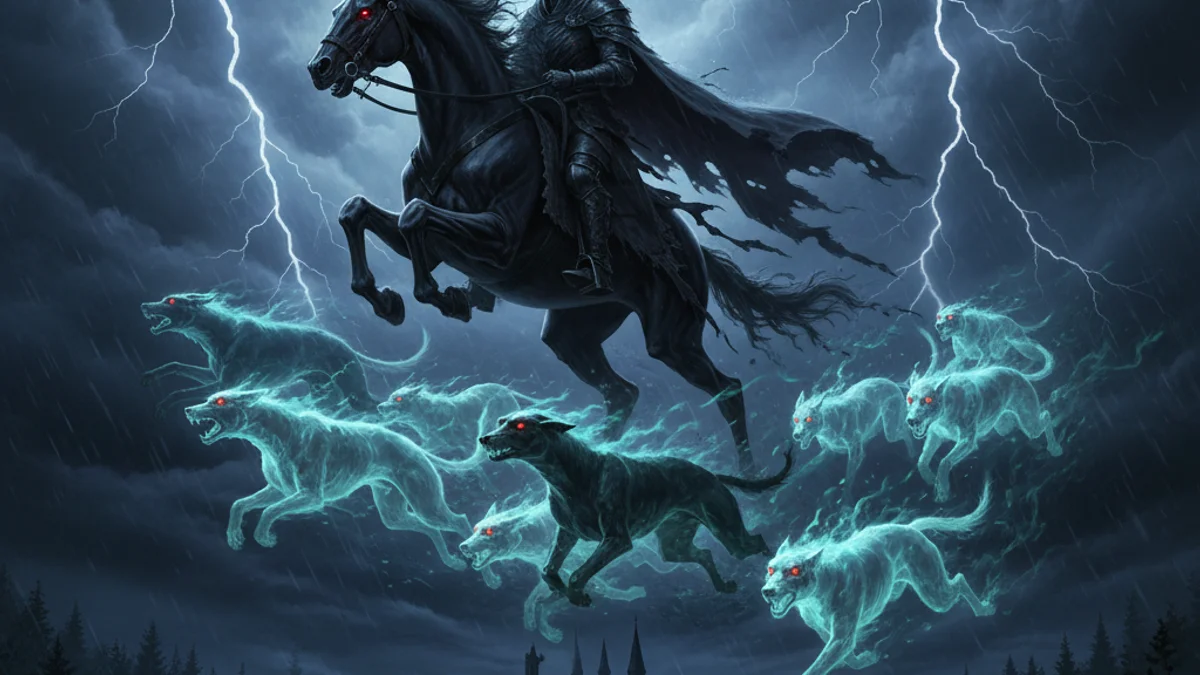
Once there lived a nobleman named Count Hackelberg, whose only passion was the hunt. He loved the baying of hounds more than the tolling of church bells and the pursuit of the stag more than his own salvation. On his deathbed, he refused the priest's blessing, declaring he wished only to hunt for eternity in the forests of the afterlife. His wish was granted, but with a dark twist. Now known as the Wild Huntsman, he is cursed to lead a spectral cavalcade through the stormy night skies. Accompanied by ghostly hounds and a skeletal steed, he chases an invisible prey across the thunderclouds, a warning to all who hear the baying in the wind that pride and obsession carry a heavy price. To this day, when the wind howls through the German forests, locals whisper that the Count is riding again.
Unchecked obsession and the neglect of one's spiritual well-being lead to eternal restlessness.
Questions about this story
What is the moral of The Wild Huntsman?
The story warns against the dangers of prioritizing worldly obsessions over spiritual peace and humility. It teaches that our earthly desires, if left unchecked, can become our eternal prisons.
Who is the Wild Huntsman based on?
In many German versions, he is identified as Count Hackelberg, though the figure is often a folkloric remnant of the god Odin. He represents the untamed power of the storm and the forest.
What does it mean to see the Wild Hunt?
Historically, witnessing the Wild Hunt was considered a terrible omen of impending war, plague, or the witness's own death. It was a sign that the boundary between the living and the dead had thinned.
Where did the legend originate?
The legend has ancient Germanic and Scandinavian roots, eventually spreading throughout Europe. It evolved from pagan mythology into a cautionary Christian folk tale about the consequences of sin.
Advertisement

Good night.
