
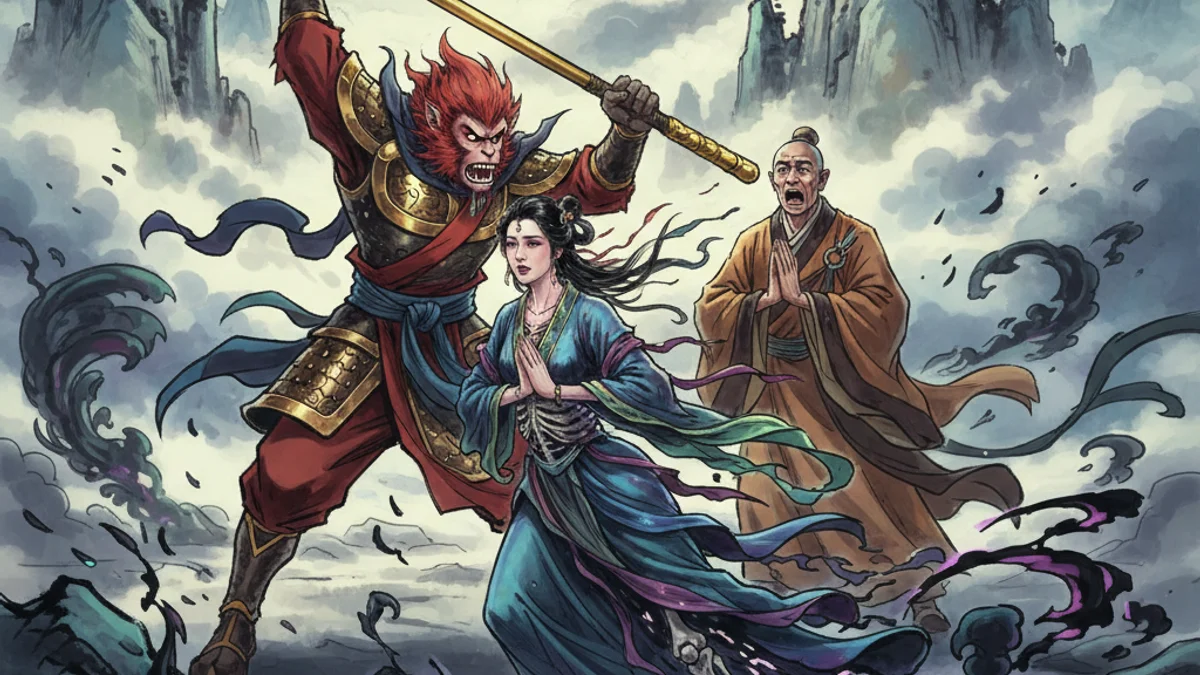
During their pilgrimage to the West, Tang Sanzang and his disciples encountered a desolate mountain range. Hidden within lived the White Bone Demon, a malevolent spirit who craved the monk's flesh for immortality. She first approached the group disguised as a beautiful young girl carrying a basket of peaches. Sun Wukong, possessing the Golden Gaze, saw through her illusion and struck her down with his staff. However, the demon escaped, leaving a fake corpse behind. Tang Sanzang was horrified by Wukong's perceived cruelty. The demon returned twice more: first as the girl’s elderly mother and then as her father, seeking their 'missing' daughter. Each time, Wukong recognized the monster and delivered a fatal blow. Seeing three 'murders' in a row, the monk was blinded by his misplaced compassion and Zhu Bajie's envious goading. Despite Wukong showing the monk that the corpses had turned into piles of skeletal remains, Tang Sanzang refused to believe his disciple and banished the Monkey King from the journey, leaving the party vulnerable to the demon's next trap.
True wisdom requires seeing beyond outward appearances, and blind compassion without discernment can lead to the betrayal of those who protect us.
Questions about this story
What is the moral of The White Bone Demon?
The story teaches that appearances are often deceiving and that one must use wisdom to distinguish truth from falsehood. It also warns against being overly stubborn in one's perceptions, as Tang Sanzang’s refusal to trust Wukong nearly led to disaster.
Why did the White Bone Demon want to catch Tang Sanzang?
In the lore of Journey to the West, it is believed that eating the flesh of the holy monk Tang Sanzang would grant a demon permanent immortality. This makes him a constant target for every monster and spirit along the silk road.
What were the three disguises used by the demon?
The White Bone Demon first disguised herself as a young girl, then as an elderly woman claiming to be the girl's mother, and finally as an old man claiming to be the father. Each form was designed to manipulate the monk's pity.
Why did Tang Sanzang banish Sun Wukong?
The monk was a man of non-violence and could not see the demon's true form. He believed Wukong had murdered three innocent civilians in cold blood and felt that such 'bloodlust' was incompatible with their sacred pilgrimage.
Advertisement
Good night.
