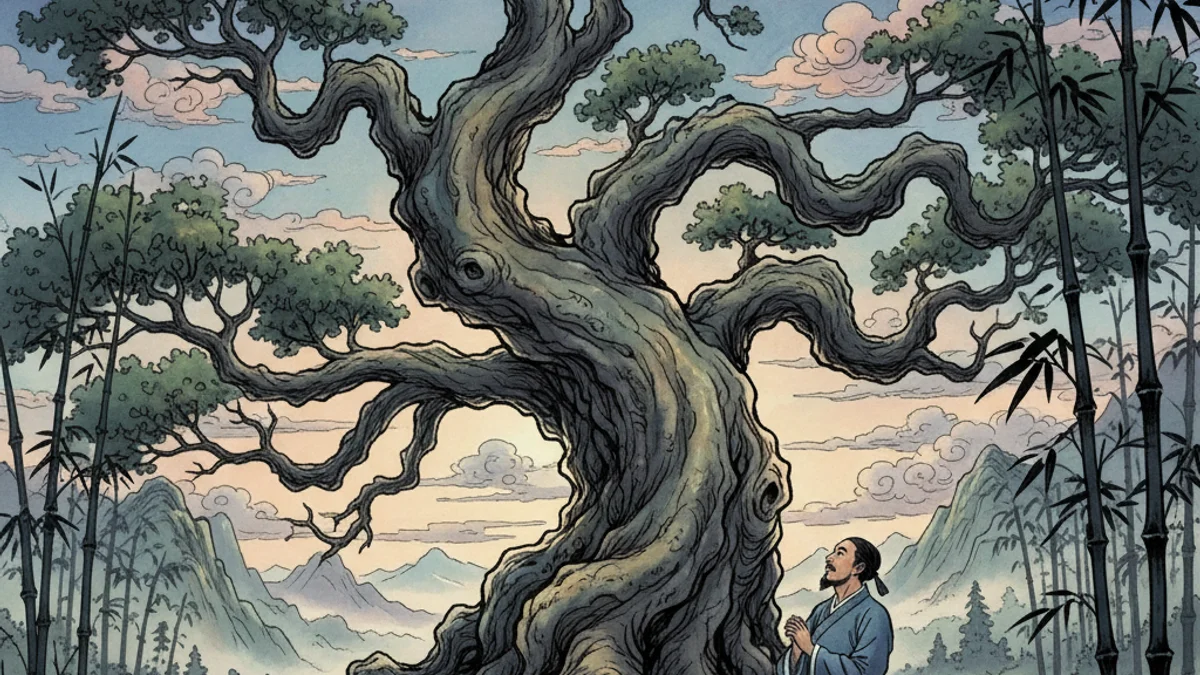
A master carpenter named Shih was traveling through the village of Chu when he encountered a massive ancient oak tree. Its branches were so sprawling they could shade thousands of oxen, and its trunk was as wide as a mountain. Shih’s apprentice marveled at it, but the master barely glanced at the tree. 'It is a useless tree,' Shih declared. 'If you make a boat from it, it will sink; if you make a coffin, it will rot; if you make a tool, it will break. It is good-for-nothing timber.' That night, the tree appeared to Shih in a dream. 'Why do you compare me to your cultivated trees?' the oak whispered. 'Fruit trees are stripped of their fruit and broken by those who want their harvest. Their utility makes their lives miserable, and they die young. I have spent a long time perfecting my uselessness. If I had been useful to you, would I have ever grown to this great size?' Shih awoke with a start, realizing that the tree had survived precisely because it served no man’s purpose but its own.
True worth is found in preserving one's inner nature rather than serving the utilitarian demands of others; what the world calls 'useless' is often the secret to freedom and longevity.
Questions about this story
What is the moral of The Useless Tree?
The story teaches that being 'useless' by worldly standards can be a form of protection. By not serving others' utilitarian needs, one preserves their own life, integrity, and inner peace.
Who wrote the story of The Useless Tree?
This famous parable is found in the writings of Zhuangzi (Chuang Tzu), a seminal figure in Taoist philosophy. It illustrates the value of non-striving and the preservation of the self.
What does the tree represent in Taoism?
The tree represents a person who follows the Tao by remaining humble and unexploited. It symbolizes the strength found in softness and the survival found in avoiding worldly ambition.
Why did the carpenter think the tree was useless?
The carpenter judged the tree based on its timber value, noting that its wood was too twisted and knotted for construction. He only saw value in how the tree could be used for human profit.
Advertisement

Good night.
