
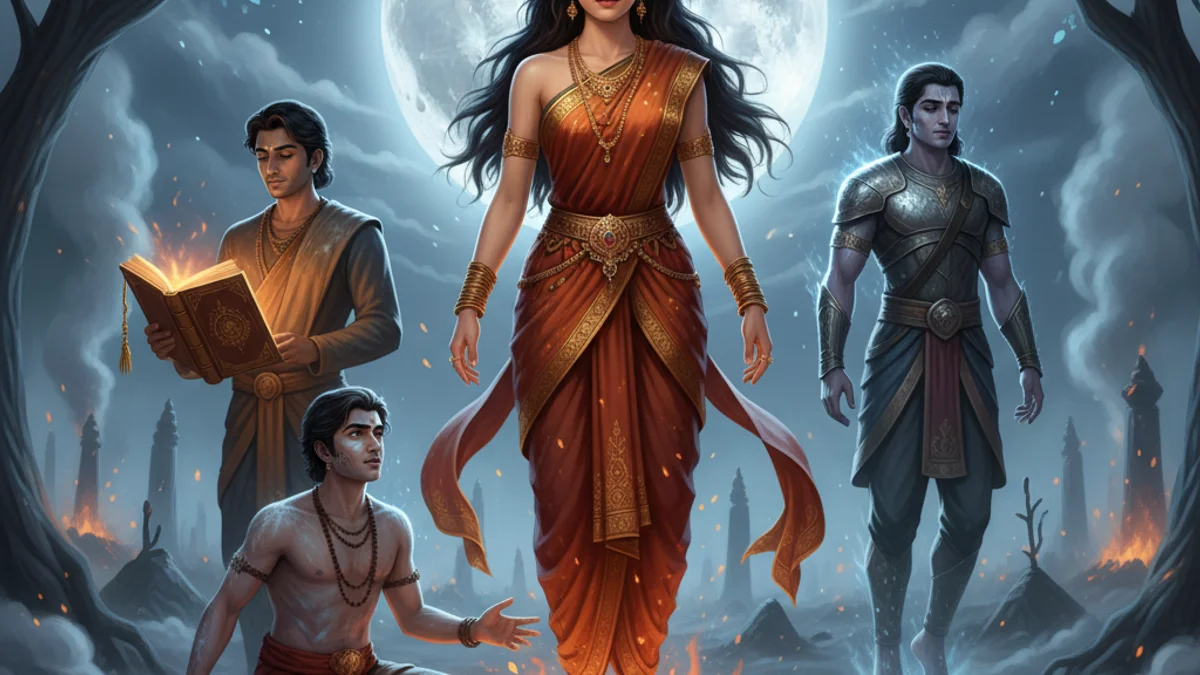
King Vikram was carrying the corpse of Betaal through the dark forest when the spirit began a tale. A beautiful maiden named Mandavati died suddenly of a snake bite, leaving three suitors heartbroken. Each expressed his grief differently: the first suitor, unable to live without her, cast himself into her funeral pyre and perished. The second suitor built a small hut by the cremation ground, living a life of austerity while guarding her ashes. The third suitor traveled to distant lands, eventually mastering the Sanjivani Mantra, a secret spell to revive the dead. Upon his return, he chanted the mantra over the ashes, and Mandavati rose again, more beautiful than before. A fierce dispute broke out over who should marry her. Betaal stopped and asked, 'O King, who is her rightful husband?' Vikram replied, 'The one who gave her life is like a father. The one who died with her is like a brother born of the same fire. Therefore, the one who stayed by her ashes and protected her memory with devotion is her rightful husband.'
True love and the role of a husband are defined by steadfast devotion and the preservation of one's partner, rather than just sacrifice or creation.
Questions about this story
What is the story of The Three Suitors in Vikram Betaal?
It is a classic riddle where three men claim the hand of a resurrected woman based on their different forms of devotion and sacrifice.
Why did Vikram say the man who stayed with the ashes was the husband?
Vikram reasoned that the reviver acted as a father by giving life, and the one who died with her was a brother; only the protector of her remains showed the duty of a husband.
Who are the three suitors in the story?
The three suitors are the man who sacrificed his life on the pyre, the man who stayed to guard the ashes, and the man who learned the mantra to revive her.
What is the Sanjivani Mantra mentioned in the tale?
In Indian folklore, the Sanjivani Mantra is a powerful sacred chant capable of bringing a dead person back to life, representing the power of knowledge.
Advertisement
Good night.
