
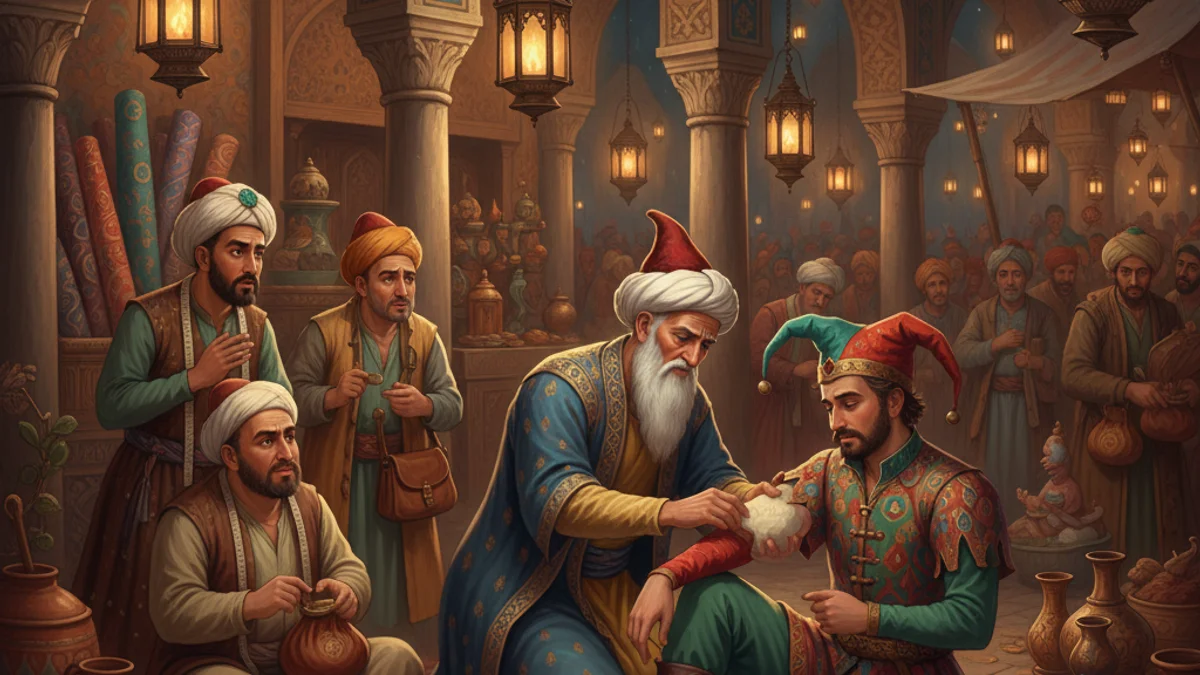
A tailor and his wife invited a jovial hunchback, the Sultan's favorite jester, to dinner in their home. During the meal, the hunchback choked on a large fishbone and fell to the floor, seemingly dead. Panicked and fearing the Sultan’s wrath, the couple carried the body to the house of a Jewish physician, leaving it on the stairs. The doctor, rushing down in the dark, accidentally kicked the body and, believing he had killed the man, passed the 'corpse' over a wall into the garden of a royal steward. The steward, mistaking the hunchback for a thief, struck him with a mallet and then, terrified of the consequences, leaned the body against a shop in the marketplace. A Christian broker, walking by in the night, accidentally bumped into the hunchback and was immediately arrested for murder. As the broker faced execution, the steward, the physician, and the tailor each came forward in succession to confess the 'crime' to save the innocent man. The Sultan, amazed by this chain of honesty, summoned his wise barber. The barber quickly realized the hunchback was not dead at all; with a deft maneuver, he extracted the fishbone from the jester's throat. The hunchback sneezed and sat up, and the Sultan, delighted by the happy ending, pardoned all involved.
Honesty and the courage to take responsibility can prevent injustice and lead to unexpected mercy.
Questions about this story
What is the moral of The Tale of the Hunchback?
The moral is that honesty and integrity are paramount, even in the face of fear. It also teaches that situations are often not as dire as they appear and that rushing to judgment can lead to grave errors.
Who actually killed the hunchback in the story?
In reality, no one killed the hunchback. He was simply unconscious after choking on a fishbone, though four different characters believed they were responsible for his death due to a series of accidents.
How does the barber save the day?
The barber is the only character observant enough to realize the hunchback is still alive. He uses his medical knowledge to remove the fishbone from the hunchback's throat, reviving him and clearing the others of murder.
Why did all the characters confess to the crime?
Each character confessed out of a sense of guilt and a desire to prevent an innocent person from being executed. This chain of confessions highlights the underlying morality of the community despite their initial attempts to hide the body.
Advertisement
Good night.
