
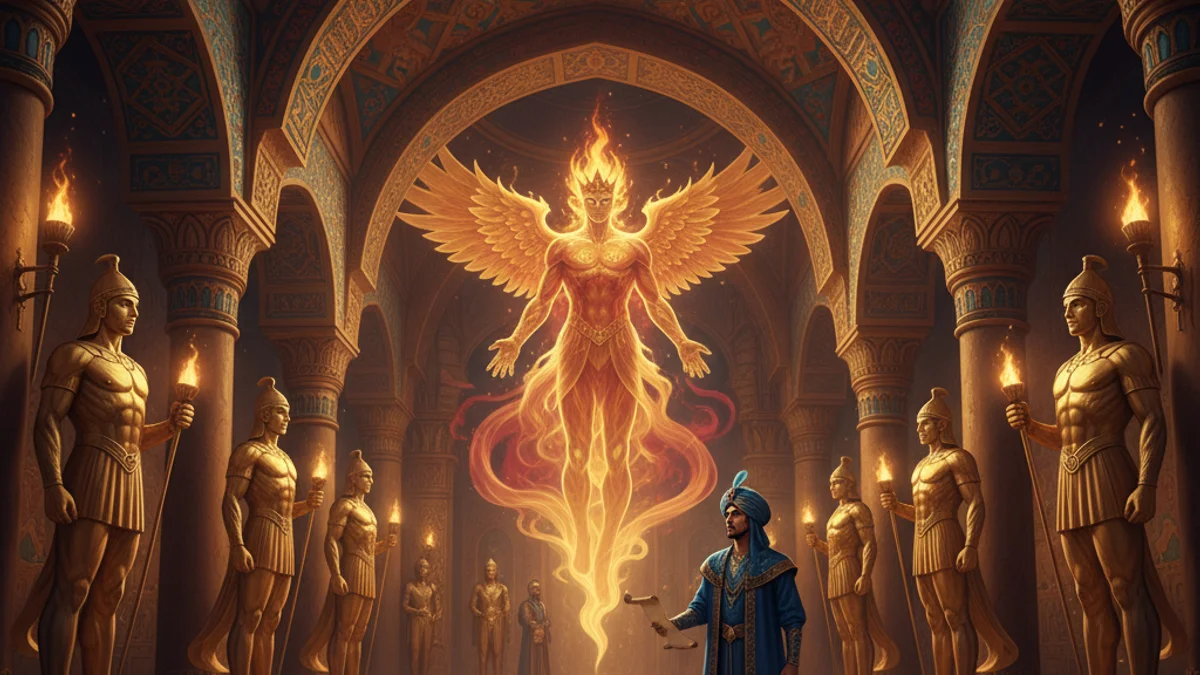
Zeyn Alasnam, the Prince of Basra, squandered his vast inheritance until he was left with nothing. A dream guided him to Cairo, where a mysterious Shaykh led him to a hidden subterranean palace built by his father. Beneath the earth, Zeyn discovered eight magnificent statues of solid gold, but a pedestal for a ninth remained empty. To claim the final, most precious statue, Zeyn struck a bargain with the King of the Jinn: he had to find a maiden of perfect virtue. Equipped with a magical mirror that only remained clear in the presence of true purity, Zeyn searched the world until he found the beautiful daughter of a vizier. Though Zeyn fell deeply in love with her during their journey, he remained faithful to his word and delivered her to the King of the Jinn. Impressed by the Prince's honor and the maiden's virtue, the King returned her to Zeyn, revealing that a virtuous wife is the ninth statue, a treasure more valuable than all the gold in the world.
True wealth is found in virtue and character rather than material riches, and keeping one's word is the mark of a noble soul.
Questions about this story
What is the moral of The Story of Prince Zeyn?
The story teaches that moral integrity and a virtuous companion are more valuable than material wealth. Zeyn's journey proves that keeping a promise is the ultimate test of character.
What does the ninth statue represent?
The ninth statue represents a virtuous and faithful woman. While the first eight were made of gold, the ninth was a living person, signifying that human virtue exceeds mineral wealth.
How did Prince Zeyn test for virtue?
Zeyn used a magical mirror given to him by the King of the Jinn. If the mirror remained clear when a maiden looked into it, she was virtuous; if it clouded, she was not.
Who is the King of the Jinn in this story?
The King of the Jinn is a powerful supernatural entity who guards the ninth statue and tests Zeyn's honor and self-control throughout his quest.
Advertisement
Teach next

Good night.
