
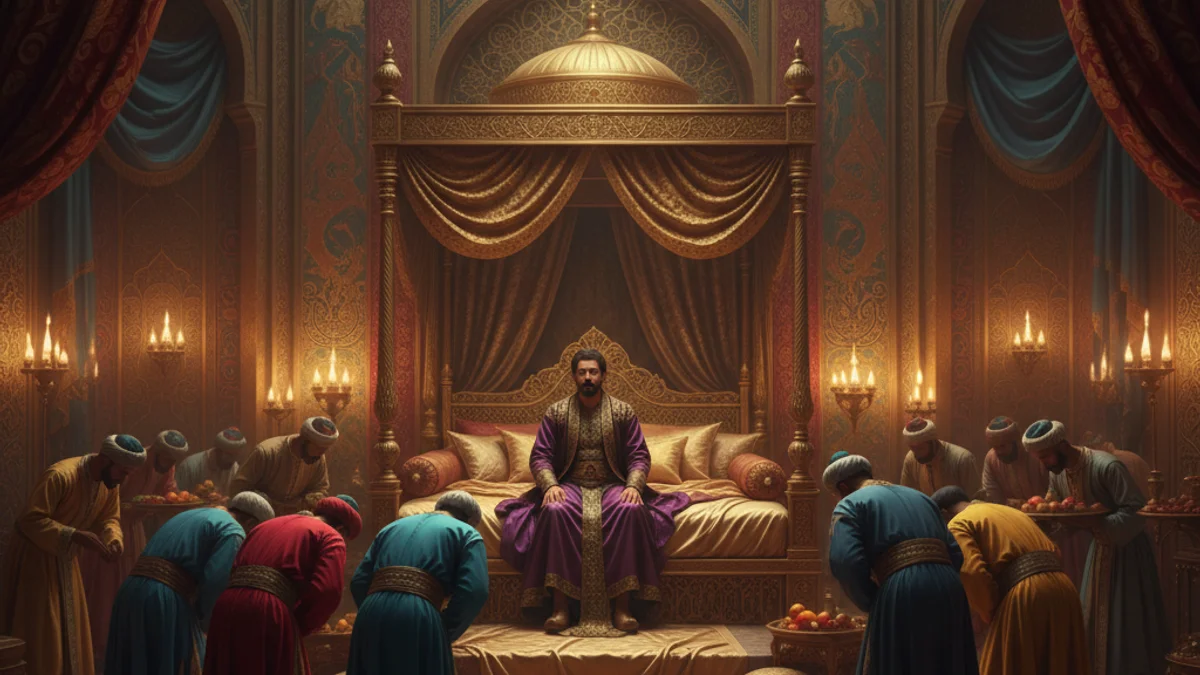
In the city of Baghdad, a wealthy man named Abu Hassan, who had spent half his fortune on pleasure and the other half on hospitality, made a vow to only entertain strangers for a single night. One evening, he hosted a merchant who was secretly the Caliph Harun al-Rashid in disguise. During their meal, Abu Hassan expressed a singular wish: to be Caliph for just one day so he could punish a neighborhood imam who harassed him. Amused, the Caliph drugged Abu Hassan’s wine and had him carried to the palace. When Abu Hassan awoke in the royal bed, surrounded by officers and silken splendor, he was treated as the true Commander of the Faithful. Though initially confused, he eventually embraced the role, ordering the punishment of the imam and distributing gold. After a day of luxury, he was drugged again and returned to his home. He awoke believing his royal life was a dream, but his conviction led to his brief imprisonment for madness. Eventually, the Caliph revealed the truth, and Abu Hassan became a favored companion at court, learning that the line between dreams and reality is thinner than one might imagine.
True power lies in the wisdom to discern reality from illusion, and kindness often yields greater rewards than temporary authority.
Questions about this story
What is the moral of The Sleeper Awakened?
The story suggests that identity and status can be fleeting and that one should remain humble regardless of their station. it also explores how perception can be easily manipulated by those in power.
Who is the protagonist in The Sleeper Awakened?
The protagonist is Abu Hassan, a generous but disillusioned man living in Baghdad who is used in a grand prank by the Caliph.
Is The Sleeper Awakened a true story?
No, it is a fictional folk tale from the 'One Thousand and One Nights' collection, though it features the historical Caliph Harun al-Rashid.
How did Abu Hassan become the Caliph for a day?
The real Caliph drugged Abu Hassan's wine and transported him to the palace, instructing all servants to treat him as the true ruler as a social experiment.
Advertisement
Good night.
