
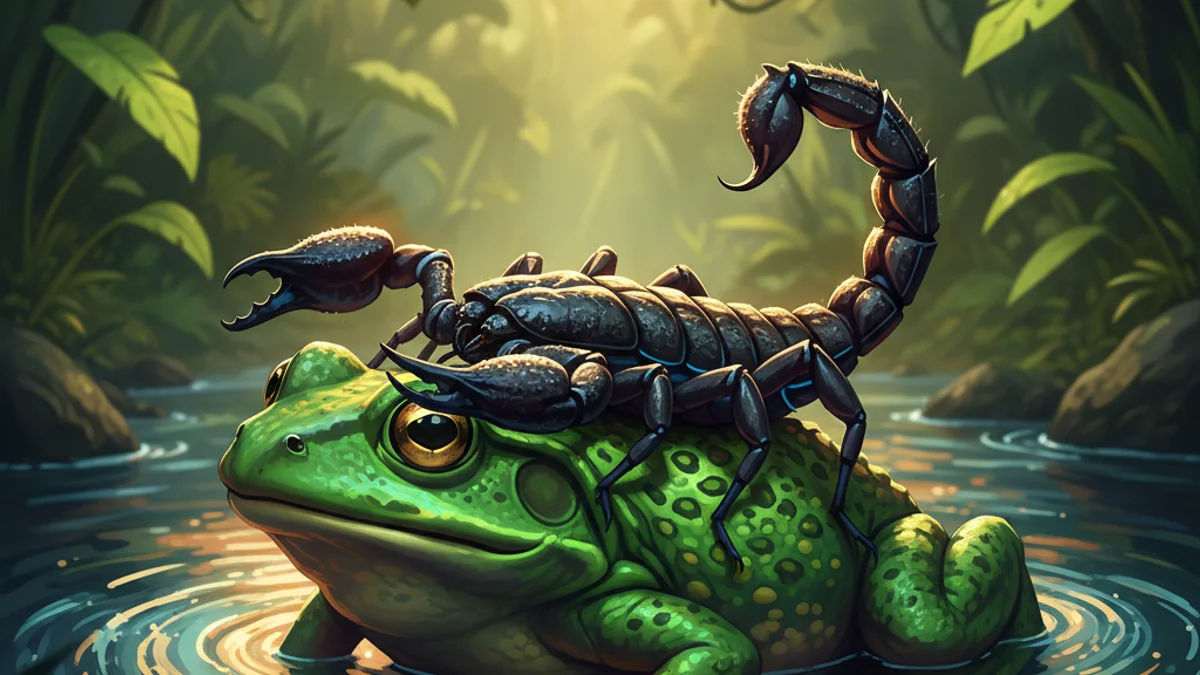
A scorpion, wishing to cross a wide river but unable to swim, spotted a frog resting by the bank. 'Kind frog,' the scorpion pleaded, 'could you carry me across on your back?' The frog hesitated, replying, 'If I do, you will surely sting me, and I shall die.' The scorpion laughed and argued, 'Why would I do that? If I were to sting you, we would both drown.' Satisfied by this logic, the frog allowed the scorpion to climb aboard and began to swim across the current. Halfway across the river, the frog felt a sharp, searing pain in his side—the scorpion had stung him. As they both began to sink into the deep water, the frog cried out in disbelief, 'Why did you do it? Now we shall both perish!' The scorpion sighed and replied, 'I could not help it. It is my nature.'
Some individuals cannot change their inherent nature, even when their actions result in their own downfall.
Questions about this story
What is the moral of The Scorpion and the Frog?
The moral is that some people have an inherent nature that they cannot change, even if it is self-destructive. It serves as a warning not to trust those who have a history of harmful behavior.
Is The Scorpion and the Frog an Aesop's fable?
Surprisingly, no. While it feels ancient, the story emerged in the early 20th century and is not found in Aesop's original collections.
Why did the scorpion sting the frog if it meant he would die too?
The scorpion acted on pure instinct rather than logic or self-preservation. This highlights the theme that nature often overrides reason.
What does the river symbolize in this fable?
The river symbolizes a journey or a challenge that requires cooperation. It acts as the setting that tests the character and integrity of both participants.
Advertisement
Read it in another language
- العقرب والضفدع · العربية
- Der Skorpion und der Frosch · Deutsch
- El escorpión y la rana. · Español
- عقرب و قورباغه · فارسی
- Le Scorpion et la Grenouille · Français
- बिच्छू और मेंढक। · हिन्दी
- Lo scorpione e la rana. · Italiano
- O Escorpião e o Sapo · Português
- Скорпион и Лягушка · Русский
- తేలు మరియు కప్ప. · తెలుగు
- Ang Alakdan at ang Palaka. · Tagalog
- Скорпіон і Жаба · Українська
- 蝎子与青蛙 · 中文

Good night.
