
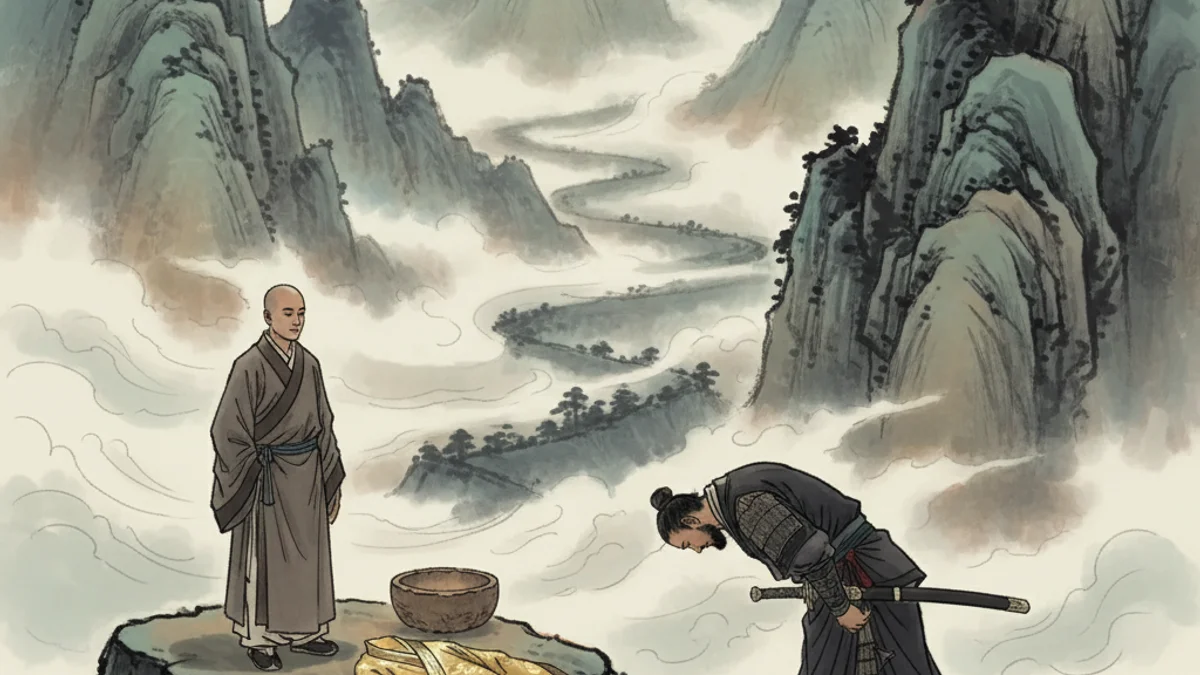
After the Sixth Patriarch Huineng received the robe and bowl of succession, he fled south to escape jealous rivals. He was pursued by hundreds, including a former general named Huiming. When Huiming finally caught him on a mountain pass, Huineng placed the robe and bowl on a rock and said, 'This robe represents faith. It cannot be taken by force.' Huiming tried to lift the items, but they remained as heavy as a mountain, unmovable. Trembling with sudden awe, Huiming cried out, 'I came for the Dharma, not for the robe!' Huineng looked at him and said, 'Thinking neither of good nor of evil, at this very moment, what is your original face before your parents were born?' Upon hearing this, Huiming experienced a profound awakening and realized his true nature.
True enlightenment is found by transcending dualistic thinking and ego to realize one's inherent, non-conceptual nature.
Questions about this story
What is the moral of The Original Face?
The story teaches that spiritual truth cannot be found through force or dualistic labels of good and evil. One must look beyond the ego to find their fundamental, unchanging nature.
Who was Huineng in Zen tradition?
Huineng is the Sixth Patriarch of Chan (Zen) Buddhism, known for his sudden enlightenment and for emphasizing that the Buddha-nature is present in all people regardless of status.
What does the 'Original Face' mean?
It refers to one's true, essential nature that exists before the development of the personality, ego, and social conditioning. It is the pure state of being.
Why couldn't Huiming lift the robe and bowl?
The items symbolize the weight of spiritual authority and faith, which cannot be claimed by physical strength or greed; they are 'heavy' with a truth that only the enlightened can carry.
Advertisement

Good night.
