
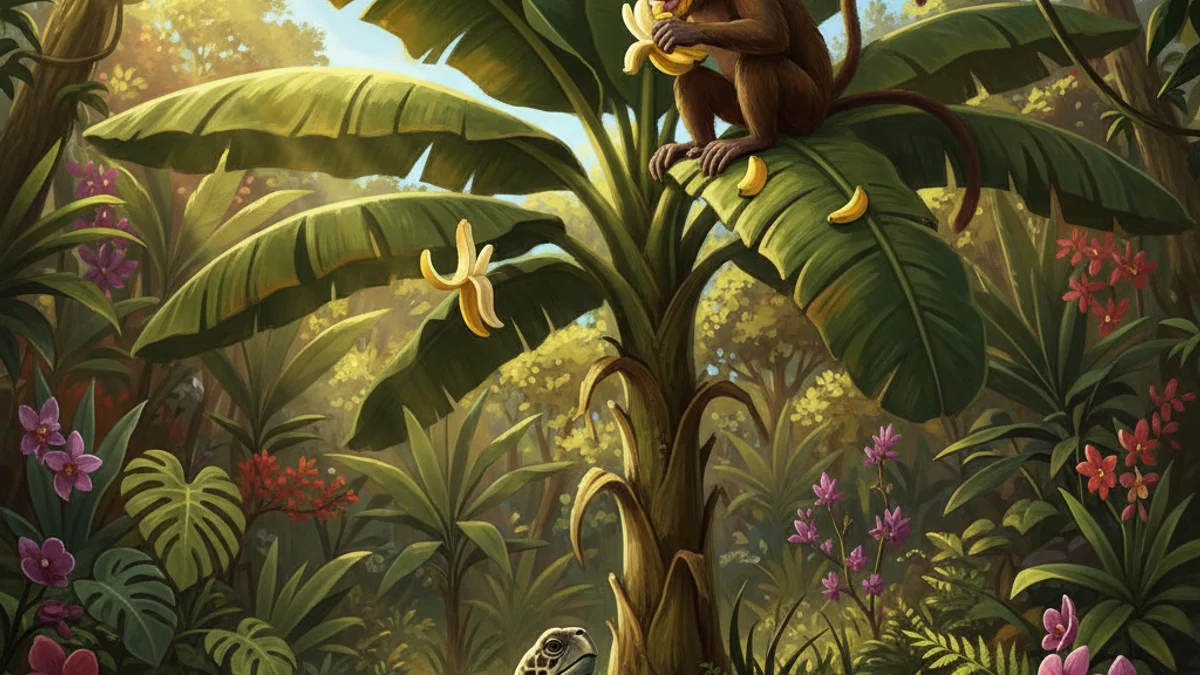
A Monkey and a Turtle once found a banana tree floating in a river and decided to divide it. The greedy Monkey insisted on taking the upper half with the leaves, believing it would grow faster, while the Turtle took the bottom half with the roots. The Monkey’s half soon withered and died, but the Turtle’s half grew into a magnificent tree laden with fruit. When the bananas ripened, the Turtle, unable to climb, asked the Monkey for help. The Monkey climbed up but greedily ate all the fruit himself, mocking the Turtle from above. In retaliation, the Turtle placed sharp shells around the tree trunk. When the Monkey slid down, he was badly cut. Furious, the Monkey caught the Turtle and threatened to either pound him in a mortar or throw him into the river. The clever Turtle cried out, 'Please, pound me to pieces, but do not throw me into the water, or I shall drown!' Thinking the river was a terrible punishment, the Monkey tossed him in. The Turtle surfaced, laughing, and reminded the Monkey that the water was his natural home.
Greed and selfishness lead to ruin, while patience and wit can overcome physical strength and bullying.
Questions about this story
What is the moral of The Monkey and the Turtle?
The story teaches that greed and selfishness lead to ruin, while patience and cleverness can overcome even the strongest bullies. It emphasizes that wit is more powerful than physical dominance.
Who popularized The Monkey and the Turtle?
While it is an ancient folk tale, the Philippine national hero Jose Rizal is credited with popularizing it. He famously illustrated the story and compared it to other world fables in the late 19th century.
Why did the Monkey's banana tree die?
The Monkey chose the upper part of the tree because it already had leaves and looked more promising. However, because it lacked roots, it could not sustain itself and eventually withered away.
How did the Turtle trick the Monkey at the river?
The Turtle used reverse psychology by pretending to be terrified of the water. By begging the Monkey not to throw him in, he ensured the Monkey would do exactly that, leading to his escape.
Advertisement

Good night.
